Communication within the Highlands, and among some of the more advance Midland communities is very much based upon the existence of the hypercable communication system which is strung along the Major Routes. Worlds located in systems within transmission distance of the subspace gates or anchored hypercable relay stations have effectively instant communication with every other world on a major route.
Subspace gates provide the conduit between the hypercable system in subspace and standard transmission in real space. Most gates are either in stellar or planetary orbit. For those in stellar orbit there would often be a noticeable lag, as gates not placed in stabilized subspace must be at least 100 solar and planetary diameters away from these bodies.
So for example in the Solar System a gate would have to be located in an orbit at least 70 million miles beyond the sun. Since the minimum distance a gate would have to be from Earth would be at least 791,000 miles it could not be placed in a standard orbit, it would most likely be placed in one of the Lagrange points which are far enough to be outside the 100 diameter limits, yet close enough to ensure both minimum transit time to Earth and minimum time lag for communication carried on electromagnetic waves (radio).
Of course the gate orbiting Earth is in stabilized subspace. A hyperdrill has been used to provide a subspace conduit that allows the gate to be place within the normally exclusive 100 diameter zone. This allows the Earth gate to be located in a geostationary orbit at approximately 22,236 miles above the equatorial Pacific Phoenix Islands.
Of course this creates another problem, which is the delay caused by the distance between Earth and the colonies in the Trans-Jupiter and farside asteroid belt.
Under normal circumstances a message transmitted from the communication array at EarthGate could require almost a hour to reach one of the moon stations at Jupiter
This problem is addressed through the use of hypercable boundary relays. A hypercable boundary relay is an unmanned station about the size of an old style bus which is place by a hyperdrill. It is place at the boundary of subspace with its body anchored to the subspace plane by a gravity anchor. Within the relay a microgate allows a transmission antenna to extend into real space. This antenna would be located within a suitable distance of Jupiter, orbiting with the planet.
So to send a message from Earth to Ganymede Base the message would be routed not to EarthGate's real space EM array, but rather through the hypercable relays already placed along the Major Route in subspace. From there it would be sent to the boundary relay, where it would then be transmitted to real space in the general vicinity of Jupiter. This results in not just effectively instant communication from Earth, but instant communication from anywhere in the Highlands.
Since for all intents and purposes everything is data the hypercable system provides the backbone for a Highland wide network of connected devices. Citizens of the Union use this network for everything from communication to entertainment. It also provides a vast repository of knowledge which is available to any world connected to the system.
But of course even in the Highlands there are many worlds not connected to the system. Worlds along Blue Highways are not hooked into the hypercable system, though it is quite possible local system wide relays might exists.
Typically worlds along Blue Highways have local networks which receive recorded data from the closest hypercable node, delivered by the Grand Postal Service. Most such systems do not have boundary relays so interplanetary communication is often plagued by time lags that make email a better communication medium than video calls. Interstellar communication is primarily via text or recorded message.
Because the network of the Major Routes do not consist of a regular pattern, but are distributed based upon world location, population, and other economic factors how a message is routed can have a significant effect on the time involved in delivering it. The Grand Postal Service spends a lot of resources determining the routes which will result in the fastest delivery of message sent to disconnected worlds.
This disjointed system often results in news being delivered almost or more rapidly by private or commercial vessels before official news organizations. Both Church and government maintain couriers in an attempt to stay ahead of rumor or even official news.
Showing posts with label Subspace. Show all posts
Showing posts with label Subspace. Show all posts
Friday, November 17, 2017


Monday, October 9, 2017
Space Combat extended
Space combat was been lightly covered in previous posts. Within the Highlands any ship-on-ship actions are primarily single ship-on-ship police or anti-piracy affairs conducted primarily by Ranger units on corvettes or schooners. From time to time a Frigate patrolling the border between the frontier and the Midlands might find itself engaged by a foreign vessel or multiple hostile vessels of a subordinate class.
Outside the Highlands, in the Midlands or the Wild large scale squadron, task force or fleet battles are much more likely. Such combat is very much different in scope and character from single ship actions. While a Frigate embarks support craft and might deploy pinnace to act as scouts or pickets or even have fighting vehicles or battleriders to act as support craft they typically do not have the long range reconnaissance or Command and Control systems necessary to engage in fleet level actions.
During one-on-one actions vessels typically depend upon their own sensor suites to locate enemy vessels, direct fire control and engage enemies.
During fleet actions major combatants, such as dreadnoughts and superdreadnoughts use pickets made up of destroyers and battleriders to deploy sensor nets, act as forward firecontrol nodes and provide support. To aid in this role destroyers tend to be light on energy weapons, but heavy on missiles. They primarily use railguns and light lasers in the anti-missile roll. Destroyers are small enough to employ relatively effective stealth and cloaking technology, like the more heavily armored battelriders.
In real space combat even the most powerful energy weapons are limited to 300,000 miles range. In subspace their range is a twentieth of that. At those ranges sensor response lags only a second. Missiles are effective at distances far beyond the range at which sensor response lags by minutes. Sensor nets can also be effectively deploy at distances which result in information minutes or hours old being the most recent data upon which response decisions must be made. Likewise large dispersed sensor nets can detect objects at distances so great that the information is an hour and a half old by the time the information reaches its control node.
Outside the Highlands, in the Midlands or the Wild large scale squadron, task force or fleet battles are much more likely. Such combat is very much different in scope and character from single ship actions. While a Frigate embarks support craft and might deploy pinnace to act as scouts or pickets or even have fighting vehicles or battleriders to act as support craft they typically do not have the long range reconnaissance or Command and Control systems necessary to engage in fleet level actions.
During one-on-one actions vessels typically depend upon their own sensor suites to locate enemy vessels, direct fire control and engage enemies.
During fleet actions major combatants, such as dreadnoughts and superdreadnoughts use pickets made up of destroyers and battleriders to deploy sensor nets, act as forward firecontrol nodes and provide support. To aid in this role destroyers tend to be light on energy weapons, but heavy on missiles. They primarily use railguns and light lasers in the anti-missile roll. Destroyers are small enough to employ relatively effective stealth and cloaking technology, like the more heavily armored battelriders.
In real space combat even the most powerful energy weapons are limited to 300,000 miles range. In subspace their range is a twentieth of that. At those ranges sensor response lags only a second. Missiles are effective at distances far beyond the range at which sensor response lags by minutes. Sensor nets can also be effectively deploy at distances which result in information minutes or hours old being the most recent data upon which response decisions must be made. Likewise large dispersed sensor nets can detect objects at distances so great that the information is an hour and a half old by the time the information reaches its control node.
Friday, September 29, 2017
Subspace Combat
In subspace combat the nature of the environment makes missiles useless. No matter how good their engines a missile effectively travels no faster than any other vehicle. This makes them easy prey for energy weapons.
Like missiles, railgun projectiles are really just matter enhanced with gravitational engines. They tend to lose momentum quickly and become ineffective at any kind of range.
Energy weapons ranges are drastically reduced, but their effectiveness within their useful range is unimpaired. Typically energy weapon ranges are reduced by 20, that is they are half as effective as they are in normal atmosphere.
Force fields are just as effective in subspace as in real space, but as a gravitic phenomenon are less detectable in the high gravametric environment of subspace. In other words a ship protected by a standard force field is harder to detect. Against the high gravometric background of subspace force field stealth technology is less effective.
On balance this makes it hard to detect protected warships at greater ranges, but distortion fields and masking are less effective at close ranges.
The heavy electromagnet interference in the subspace environment makes long range and active sensors not nearly as good as in real space. This is one reason road beacon stations are seeded so close together and why off road vehicles and ships must depend upon inertial navigation and gravitational topology plotting and can only detect subspace beacons when they are fairly close to the system that has anchored them. This also makes the kinds of weapon ranges seen in real space battles untenable in subspace. Because of the high EM background EM masking and stealth become more effective.
Once away from the beacon stations of the Major Routes and Blue Highways accidentally meeting another vessel is unlikely. So battles in subspace tend to occur at gates or near system beacons. Of course this is where systems concentrate their own defenses when they expect an attack as well as where standard defenses are anchored.
Like missiles, railgun projectiles are really just matter enhanced with gravitational engines. They tend to lose momentum quickly and become ineffective at any kind of range.
Energy weapons ranges are drastically reduced, but their effectiveness within their useful range is unimpaired. Typically energy weapon ranges are reduced by 20, that is they are half as effective as they are in normal atmosphere.
Force fields are just as effective in subspace as in real space, but as a gravitic phenomenon are less detectable in the high gravametric environment of subspace. In other words a ship protected by a standard force field is harder to detect. Against the high gravometric background of subspace force field stealth technology is less effective.
On balance this makes it hard to detect protected warships at greater ranges, but distortion fields and masking are less effective at close ranges.
The heavy electromagnet interference in the subspace environment makes long range and active sensors not nearly as good as in real space. This is one reason road beacon stations are seeded so close together and why off road vehicles and ships must depend upon inertial navigation and gravitational topology plotting and can only detect subspace beacons when they are fairly close to the system that has anchored them. This also makes the kinds of weapon ranges seen in real space battles untenable in subspace. Because of the high EM background EM masking and stealth become more effective.
Once away from the beacon stations of the Major Routes and Blue Highways accidentally meeting another vessel is unlikely. So battles in subspace tend to occur at gates or near system beacons. Of course this is where systems concentrate their own defenses when they expect an attack as well as where standard defenses are anchored.
Friday, August 26, 2011
Blue Highways
Blue Highways are the secondary subspace routes of the Highlands. Blue Highways are routes which do not have hypercable communication stations seeded along their route. Beacon stations are located farther apart and the Department of Roads does not have as many gravitational weather stations located along the route. This makes travelling along the Blue Highways marginally more dangerous than along the Major routes. Travel is also generally slower. This is reflected in the subspace quality factor. Blue Highways generally have had less spatial stabilization. Portal Gates generally tend to be located outside the 100 diameter limit, in orbit around the stellar primary. This is less convenient.
Waystations are also fewer and farther between. A greater majority of travel along the Blue Highways consists of commercial traffic. Hypertrains do not run along these routes, so most passenger traffic goes by hyperbus, a much less comfortable mode of travel. It also much slower than hypertrain travel as there are stop overs every few days at the waystations that do exists.
Most cartage goes by hyperlorries.
The lack of hypercable means that information travels no faster than the Courier vessels of the Grand Postal System. Worlds on the Blue Highways are often thought of as a little behind the times by the inhabitants of the population centers on the Major Routes. The Church tends to be fairly strong on these worlds, its clerics and orders often receiving news via the Church's own couriers before it is delivered by the Post.
Many religious orders and lay organizations provide both help to travelers and relief to natives.
The Shelta, itinerant trader/technicians travel the Blue Highways in their caravans of hypershuttles. Most are devout sons and daughters of the Church, though often accused of having odd interpretations of some of the commandments (most especially the sixth and seventh,) on worlds where their travelling lifestyle is looked on with suspicion. On many worlds their talents with machinery and technology are welcomed. They often seem to have the right materials and design specs for hard to get spares and some seem to be almost able to talk to technology. They are often associated with the Grey Friars of the Renewal, who often seem to travel with the Shelta caravans, both seeing to their spiritual needs and smoothing over problems with locals. Along with hyperlorries and HUVs, they are a common sight on the Blue Highways.
Outside the Highlands almost every route could be considered a Blue Highway. Most of these routes are toll roads, either privately owned or short routes joining the worlds of a petty collection of worlds. Some few are extensions of the Grand Human Union, expanding into the Midlands.
Within the Highlands the Department of Roads in constantly upgrading existing Blue Highways to Major Routes, stringing hypercable stations along improved spacial structures in subspace. Likewise the Blue Highways themselves are extended to otherwise disconnected worlds, previously only open to traffic with hypershunting capability. Even so some worlds will never be connect via Blue Highways, and some that are will never get hypercable.
Waystations are also fewer and farther between. A greater majority of travel along the Blue Highways consists of commercial traffic. Hypertrains do not run along these routes, so most passenger traffic goes by hyperbus, a much less comfortable mode of travel. It also much slower than hypertrain travel as there are stop overs every few days at the waystations that do exists.
Most cartage goes by hyperlorries.
The lack of hypercable means that information travels no faster than the Courier vessels of the Grand Postal System. Worlds on the Blue Highways are often thought of as a little behind the times by the inhabitants of the population centers on the Major Routes. The Church tends to be fairly strong on these worlds, its clerics and orders often receiving news via the Church's own couriers before it is delivered by the Post.
Many religious orders and lay organizations provide both help to travelers and relief to natives.
The Shelta, itinerant trader/technicians travel the Blue Highways in their caravans of hypershuttles. Most are devout sons and daughters of the Church, though often accused of having odd interpretations of some of the commandments (most especially the sixth and seventh,) on worlds where their travelling lifestyle is looked on with suspicion. On many worlds their talents with machinery and technology are welcomed. They often seem to have the right materials and design specs for hard to get spares and some seem to be almost able to talk to technology. They are often associated with the Grey Friars of the Renewal, who often seem to travel with the Shelta caravans, both seeing to their spiritual needs and smoothing over problems with locals. Along with hyperlorries and HUVs, they are a common sight on the Blue Highways.
Outside the Highlands almost every route could be considered a Blue Highway. Most of these routes are toll roads, either privately owned or short routes joining the worlds of a petty collection of worlds. Some few are extensions of the Grand Human Union, expanding into the Midlands.
Within the Highlands the Department of Roads in constantly upgrading existing Blue Highways to Major Routes, stringing hypercable stations along improved spacial structures in subspace. Likewise the Blue Highways themselves are extended to otherwise disconnected worlds, previously only open to traffic with hypershunting capability. Even so some worlds will never be connect via Blue Highways, and some that are will never get hypercable.
Friday, August 5, 2011
Gravity Drives
The Barnes-Gutierrez Hyperspace Engine is a form of gravity drive. A gravity drive is a type of propulsion engine which operates by manipulating space-time. A gravity drive produces a "bubble" which is gravitationally isolated from the rest of space-time. This produces a number of effects which define the operational characteristics of the Barnes-Gutierrez Hyperspace Engine.
The interface or topological surface produced by the B/G engine is called the Barnes Manifold. Mass inside the Barnes Manifold is accelerated by the engine without translating the resultant inertial force to the the field's interior. In other words, inside the Barnes Manifold the usual acceleration force is not present. As a matter of fact vehicles and spacecraft which use Barnes-Gutierrez Hyperspace Engines require an artificial gravity web to maintain a comfortable gravity field, else the occupants would be weightless. This means that a passenger in a vehicle using a B/G Engine will feel neither acceleration nor deceleration. This allows such vehicles to perform hairpin turns, rapid changes in acceleration, and high speed stops, without fear of injuring the occupants. This also means that a spacecraft utilizing a Barnes-Gutierrez Engine can provide thrust in any direction without the vessel changing orientation.
The strength and permeability of the Manifold Interface is a function of its size and differential interaction with outside space. So micro B/G Engines, such as are used by smart ammunition, have very weak Barnes Manifolds even though they accelerate at >200,000 Gs. A full size space vessel, accelerating at only dozens of Gs will have a substantial, and well defined Barnes Manifold. The Manifold Interface acts as a buffer between particles outside the field and those inside the field. That means that even without a force field, a craft with a Barnes-Gutierrez Hyperspace Engine provides it's own radiation shield and protection against particulate radiation and even micrometeorites. The higher the acceleration the better the protection. The lower the acceleration the less protection.
Most spacecraft using reaction engines accelerate for approximately one half of a trip through space and then turn over to use their engines to decelerate for the second half of the journey to arrive at their destination with approximately zero residual velocity. Because a Barnes-Gutierrez Engine can produce thrust in any direction it is not required for a spacecraft equipped with one to "flip" during a typical journey. Most spacecraft that use reaction drives will adjust pitch and yaw through the use of small reaction engines. A vessel equipped with a Barnes-Gutierrez Engine can control its facing by manipulating the slip along the Barnes Manifold Interface such that the vessel can easily be set to any heading.
Because facing is not terribly relevant for a large vessel using a Barnes-Gutierrez Hyperspace Engine many are spherical with a fore and aft section designated more for reasons of tradition than from need. Such vessels typically maintain a single heading during a voyage, changing the vector of their thrust rather than their heading.
Because it is a form of gravity drive a Barnes-Gutierrez Hyperspace Engine behaves differently in subspace. On the gravitational topology of subspace too much gravitational thrust will actually result in a contra-gravitational force causing a vessel to lose velocity rather than gain it. To allow a vessel to move through subspace a Barnes-Gutierrez Hyperspace Engine must be adjusted to match local gravitational conditions. The vessel will then move at a more or less constant velocity unless affected by local gravitational eddies.
With proper modification a Barnes-Gutierrez Hyperspace Engine can open a temporary conduit to subspace. This is called shunting. A Barnes-Gutierrez Engine cannot provide both acceleration and open a shunt at the same time. This is a limitation of the nature of space-time and not of the engine itself. No one foolish enough to attempt to operate two engines in the same vessel, in different modes at the same time has survived to explain the result.
Engines operating in acceleration mode can easily coexists, though two vessels operating at high accelerations, with well defined Barnes Manifolds will have problems trying to dock. The effects will not be catastrophic, the vessels will simply tend to push each other away. This makes it easy to launch battleriders or shuttles even at high acceleration, but difficult to recover them without moving at a constant velocity.
Most spacecraft using reaction engines accelerate for approximately one half of a trip through space and then turn over to use their engines to decelerate for the second half of the journey to arrive at their destination with approximately zero residual velocity. Because a Barnes-Gutierrez Engine can produce thrust in any direction it is not required for a spacecraft equipped with one to "flip" during a typical journey. Most spacecraft that use reaction drives will adjust pitch and yaw through the use of small reaction engines. A vessel equipped with a Barnes-Gutierrez Engine can control its facing by manipulating the slip along the Barnes Manifold Interface such that the vessel can easily be set to any heading.
Because facing is not terribly relevant for a large vessel using a Barnes-Gutierrez Hyperspace Engine many are spherical with a fore and aft section designated more for reasons of tradition than from need. Such vessels typically maintain a single heading during a voyage, changing the vector of their thrust rather than their heading.
Because it is a form of gravity drive a Barnes-Gutierrez Hyperspace Engine behaves differently in subspace. On the gravitational topology of subspace too much gravitational thrust will actually result in a contra-gravitational force causing a vessel to lose velocity rather than gain it. To allow a vessel to move through subspace a Barnes-Gutierrez Hyperspace Engine must be adjusted to match local gravitational conditions. The vessel will then move at a more or less constant velocity unless affected by local gravitational eddies.
With proper modification a Barnes-Gutierrez Hyperspace Engine can open a temporary conduit to subspace. This is called shunting. A Barnes-Gutierrez Engine cannot provide both acceleration and open a shunt at the same time. This is a limitation of the nature of space-time and not of the engine itself. No one foolish enough to attempt to operate two engines in the same vessel, in different modes at the same time has survived to explain the result.
Engines operating in acceleration mode can easily coexists, though two vessels operating at high accelerations, with well defined Barnes Manifolds will have problems trying to dock. The effects will not be catastrophic, the vessels will simply tend to push each other away. This makes it easy to launch battleriders or shuttles even at high acceleration, but difficult to recover them without moving at a constant velocity.
Sunday, July 31, 2011
Subspace Transition
The Fabury Gate is located in planetary orbit far inside the planet's shunt limit. Besides the obvious convenience of having the gate just above the planet this location also means that no raiders or other enemies can simply shunt in to attack the gate, though this far inside the Highland such attacks are almost completely unknown.
As Trinity approached the man made interface between real and subspace gate control requested the craft follow a specific vector and set its autopilot on the far-side beacon. Through the gate the swirling photon field of subspace shown like an abstract masterwork. As the schooner penetrated the interface her measured forward velocity seemed to be reduced, as if she had dived into a body of syrup. Darvis reconfigured the drive for subspace service, reducing its output until the vessel sprang forward.
Outside, the tunnel like aspect of the conduit, the hyperdrill stabilized gravity structure which allowed vessels to reach the orbital gate-portal without being torn apart by the gravitational shear plane generated by Faury's planetary plateau, surround the vessel. Darvis could see another vessel ahead. The gravscanner showed two more vessels beyond his vision, hidden in the fog like photon field of subspace.
The VORN showed the conduit end-beacon as the schooner left the conduit behind. The beacons for St. Pilimon up road and Grendmouth down road blinked on the display, as the automatic piloting computer awaited his verification. Darvis acknowledged the Grendmouth beacon icon and the Trinity's pilot computer turned the ship to follow the series of beacons. The counter showed 6 days estimated flight time until Grendmouth.
The gravscanner showed the gravity plateau of Fabury falling behind, and the very much larger plateau of Fabury's primary beyond the curved display of the routing beacons. Below and above the shear planes of subspace waited for anyone unwary enough to leave the well marked Major route.
Darvis made sure the computer was monitoring the DOR storm watch channel, broadcast from the hypercable links on the beacon stations. He then left the bridge computer to its work.
As Trinity approached the man made interface between real and subspace gate control requested the craft follow a specific vector and set its autopilot on the far-side beacon. Through the gate the swirling photon field of subspace shown like an abstract masterwork. As the schooner penetrated the interface her measured forward velocity seemed to be reduced, as if she had dived into a body of syrup. Darvis reconfigured the drive for subspace service, reducing its output until the vessel sprang forward.
Outside, the tunnel like aspect of the conduit, the hyperdrill stabilized gravity structure which allowed vessels to reach the orbital gate-portal without being torn apart by the gravitational shear plane generated by Faury's planetary plateau, surround the vessel. Darvis could see another vessel ahead. The gravscanner showed two more vessels beyond his vision, hidden in the fog like photon field of subspace.
The VORN showed the conduit end-beacon as the schooner left the conduit behind. The beacons for St. Pilimon up road and Grendmouth down road blinked on the display, as the automatic piloting computer awaited his verification. Darvis acknowledged the Grendmouth beacon icon and the Trinity's pilot computer turned the ship to follow the series of beacons. The counter showed 6 days estimated flight time until Grendmouth.
The gravscanner showed the gravity plateau of Fabury falling behind, and the very much larger plateau of Fabury's primary beyond the curved display of the routing beacons. Below and above the shear planes of subspace waited for anyone unwary enough to leave the well marked Major route.
Darvis made sure the computer was monitoring the DOR storm watch channel, broadcast from the hypercable links on the beacon stations. He then left the bridge computer to its work.
Tuesday, June 7, 2011
Subspace Travel
Estimated travel times given in the Barnes-Gutierrez Hyperspace Engine entry are averages. The Quality Factors assume specifics about both the route and the vessel. For example the 1.00 Quality Factor for Major Routes assumes the route takes advantage of natural subspace topology and artificial stabilization using hyperspace drills. It also assumes an average arm stellar density. Near the edges subspace travel will be less easy and as much as a 10% penalty due to bad conditions are possible. Unforeseen subspace storms are also possible. However storms are more likely in areas of high stellar density than areas of low stellar densities. So in High density regions vessels might go faster, but they are more likely to meet unexpected gravity shear planes. Even in the best conditions a ship will be limited to no more than 10% over the subspace Quality Factor.
Further assumptions for travel along Major Routes are that the navigation beacon system is fully operational, and that the vessel has an operational VORN system. Similar assumptions hold for Blue Highways. On these routes the marking beacons are farther apart and the subspace topology itself not as structured. Department of Roads Storm Watch are less prevalent and the lack of an hyperspace cable system makes warnings a matter of minutes rather than hours or days.
Off the routes travel time is even more uncertain. If the destination world maintains a beacon, and if the gravitational topology is well known, a properly outfitted ship, that is one with a gravscanner and a quality Inertial Navigation System can usually maintain the listed Quality Factor. A good rutter can knock 5% off that time, provided it is accurate. For a ship's master familiar with the local conditions in such a vessel 10% might even be possible.
A poorly outfitted ship, without a gravscanner, or with an inferior one, traveling though unfamiliar subspace can easily make only half the usual quality factor, less if storms make areas of subspace impassible for a time.
It is also possible for local gravitational eddies to allow one vessel to outpace another. Experienced masters can often, by using sensor information from a gravscanner, ride these local eddies to gain an advantage in combat or trade. Such instabilities are rare along the groomed Major Routes or Highways, but rather more common off the grid.
Further assumptions for travel along Major Routes are that the navigation beacon system is fully operational, and that the vessel has an operational VORN system. Similar assumptions hold for Blue Highways. On these routes the marking beacons are farther apart and the subspace topology itself not as structured. Department of Roads Storm Watch are less prevalent and the lack of an hyperspace cable system makes warnings a matter of minutes rather than hours or days.
Off the routes travel time is even more uncertain. If the destination world maintains a beacon, and if the gravitational topology is well known, a properly outfitted ship, that is one with a gravscanner and a quality Inertial Navigation System can usually maintain the listed Quality Factor. A good rutter can knock 5% off that time, provided it is accurate. For a ship's master familiar with the local conditions in such a vessel 10% might even be possible.
A poorly outfitted ship, without a gravscanner, or with an inferior one, traveling though unfamiliar subspace can easily make only half the usual quality factor, less if storms make areas of subspace impassible for a time.
It is also possible for local gravitational eddies to allow one vessel to outpace another. Experienced masters can often, by using sensor information from a gravscanner, ride these local eddies to gain an advantage in combat or trade. Such instabilities are rare along the groomed Major Routes or Highways, but rather more common off the grid.
Thursday, March 3, 2011
Transmat Portals
Though the theoretical possibility of transmat technology was revealed by the work of the renowned physicist Fr. Borland Barnes in the early years of the twenty-third century it was not until the middle of that century that transmat portals became a reality.
Large masses in real space are reflected in subspace topology as gravitational plateaus separated from the subspace ground plane by massive gravitational shear planes. The plateaus float on the subspace ground plane their isolation from the rest of subspace imposed by the destructive shear planes.
A transmat portal is a subspace gate, which is made by using a hyperspace drill to create an opening to subspace which is located on the gravitational plateau which is the reflection of a world. It is connected to another portal which opens out to normal space at another location on the same plateau, the same world. The hyperspace drill creates the virtual tunnel which allows the gates to be placed back to back in subspace yet open to portals many thousands of miles apart in real space.
In the early years of their construction transmat gates were rare and most often used to supplement other forms of transportation. A high speed train or road which goes through a transmat portal can span continents in an instant. As transmat technology became cheaper to utilize public pedestrian transmat portals become common. Eventually private transmat portals were possible to allow those who could afford them the capability to go from an office or apartment in the city to a home on a tropical island in an instant.
An individual transmat portal opens exclusively to its matching portal. Each gate is placed utilizing a hyperspace drill. No action by the user of the portal is required. They just have to step through. It is possible to have many transmat portals in the same area, all leading to different destinations. However a large number of subspace openings in an area does require that the subspace structure be gravitationally fortified. This is one of the functions of the hyperdrill, to stabilize subspace topology in an area where a large number of gate portals have been constructed.
On TL B worlds it is still common to see individual gates which lead to a single destination. On TL A worlds it is much more common for public transmat portals to be located at transmat terminals. A transmat terminal has a large number of gates, usually arrange in some kind of logical sequence, leading to various remote locations. Some of them will lead to other terminals. Others to single remote gate portals. There is often a nominal fee for using a portal, typically no more than a milli or two, although some portals are free to use. For example, the Blakely Square portal leading to the Shrine of Our Lady of WoodSocket does not charge a fee for use. There is usually not a separate fee charged to passengers if a train uses a transmat portal on its regular route. There may be a toll if a road utilizes a transmat portal.
Large masses in real space are reflected in subspace topology as gravitational plateaus separated from the subspace ground plane by massive gravitational shear planes. The plateaus float on the subspace ground plane their isolation from the rest of subspace imposed by the destructive shear planes.
A transmat portal is a subspace gate, which is made by using a hyperspace drill to create an opening to subspace which is located on the gravitational plateau which is the reflection of a world. It is connected to another portal which opens out to normal space at another location on the same plateau, the same world. The hyperspace drill creates the virtual tunnel which allows the gates to be placed back to back in subspace yet open to portals many thousands of miles apart in real space.
In the early years of their construction transmat gates were rare and most often used to supplement other forms of transportation. A high speed train or road which goes through a transmat portal can span continents in an instant. As transmat technology became cheaper to utilize public pedestrian transmat portals become common. Eventually private transmat portals were possible to allow those who could afford them the capability to go from an office or apartment in the city to a home on a tropical island in an instant.
An individual transmat portal opens exclusively to its matching portal. Each gate is placed utilizing a hyperspace drill. No action by the user of the portal is required. They just have to step through. It is possible to have many transmat portals in the same area, all leading to different destinations. However a large number of subspace openings in an area does require that the subspace structure be gravitationally fortified. This is one of the functions of the hyperdrill, to stabilize subspace topology in an area where a large number of gate portals have been constructed.
On TL B worlds it is still common to see individual gates which lead to a single destination. On TL A worlds it is much more common for public transmat portals to be located at transmat terminals. A transmat terminal has a large number of gates, usually arrange in some kind of logical sequence, leading to various remote locations. Some of them will lead to other terminals. Others to single remote gate portals. There is often a nominal fee for using a portal, typically no more than a milli or two, although some portals are free to use. For example, the Blakely Square portal leading to the Shrine of Our Lady of WoodSocket does not charge a fee for use. There is usually not a separate fee charged to passengers if a train uses a transmat portal on its regular route. There may be a toll if a road utilizes a transmat portal.
Monday, February 7, 2011
Gravity Physics
Many of the technological innovations and linchpins of civilization in the New Diasporia Universe are based on gravity science. They will be covered in detail in following posts, or have already been covered in some detail previously. This is an overview of the most important technologies.
The Barnes-Gutierrez Hyperspace Engine is a device based on gravity science, in both its reactionless gravity drive and in its subspace shunt capability.
Likewise the Hyperdrill and Transmat Portal are devices based on gravity technology. The Hyperspace Drill not only allows a more or less permanent portal to be created between subspace and real space, but it is also capable to stabilizing real space and attenuating the gravity shear plane in subspace that prevents vessels from shunting too close to a planetary body. This allows a portal gate to be placed in relatively safe and very convenient planetary orbit, rather than a minimum of 100 diameters from a planetary mass.
Gravscanners are sensors capable of detecting the space distortions produced by gravitic devices, such as hyperdrills, contragrav, or from natural sources of gravity such as planets, stars and subspace topology.
Proximity Detectors are sensor which use gravscanner technology to detect nearby objects, such as other vehicles.
Artificial Gravity can be used to provide an isolated gravity field in a vehicle, on a platform or a building. This can be used to isolate people from acceleration effects or to protect from the effects of excessive or too little natural gravity.
Contragravity acts as a screen against natural gravity, which allows vehicles, platforms or even buildings or cities to float. In order to actually fly some sort of propulsion is necessary, typically a B/G engine.
Gravity Anchors are devices which stabilize and fix the location of a vehicle or other structure using contragravity through the use of tractor/pressor technology. A gravity anchor can also be used to hold a structure in fix position on the subspace plane.
A Tractor/Pressor beam device can be used to remotely handle objects or even vehicles through gravity manipulation. Pressor beams can be used to repulse missiles or bullets very much like a force shield, which is a related gravitic technology.
A Gravitic Multitool is a pocket device which can be used to manipulate objects, even inside other objects. It can turn screws, manipulate mechanical locks, even be used for surgery, although typically a gravitic surgical manipulator would be used for that job.
A Force Field is a field which can be used to protect a person, vehicle or other structure. The properties of a force field can be manipulated so that it will provide different levels of protection against differing threats.
The Barnes-Gutierrez Hyperspace Engine is a device based on gravity science, in both its reactionless gravity drive and in its subspace shunt capability.
Likewise the Hyperdrill and Transmat Portal are devices based on gravity technology. The Hyperspace Drill not only allows a more or less permanent portal to be created between subspace and real space, but it is also capable to stabilizing real space and attenuating the gravity shear plane in subspace that prevents vessels from shunting too close to a planetary body. This allows a portal gate to be placed in relatively safe and very convenient planetary orbit, rather than a minimum of 100 diameters from a planetary mass.
Gravscanners are sensors capable of detecting the space distortions produced by gravitic devices, such as hyperdrills, contragrav, or from natural sources of gravity such as planets, stars and subspace topology.
Proximity Detectors are sensor which use gravscanner technology to detect nearby objects, such as other vehicles.
Artificial Gravity can be used to provide an isolated gravity field in a vehicle, on a platform or a building. This can be used to isolate people from acceleration effects or to protect from the effects of excessive or too little natural gravity.
Contragravity acts as a screen against natural gravity, which allows vehicles, platforms or even buildings or cities to float. In order to actually fly some sort of propulsion is necessary, typically a B/G engine.
Gravity Anchors are devices which stabilize and fix the location of a vehicle or other structure using contragravity through the use of tractor/pressor technology. A gravity anchor can also be used to hold a structure in fix position on the subspace plane.
A Tractor/Pressor beam device can be used to remotely handle objects or even vehicles through gravity manipulation. Pressor beams can be used to repulse missiles or bullets very much like a force shield, which is a related gravitic technology.
A Gravitic Multitool is a pocket device which can be used to manipulate objects, even inside other objects. It can turn screws, manipulate mechanical locks, even be used for surgery, although typically a gravitic surgical manipulator would be used for that job.
A Force Field is a field which can be used to protect a person, vehicle or other structure. The properties of a force field can be manipulated so that it will provide different levels of protection against differing threats.
Thursday, February 3, 2011
Hypertrain II
Hypertrains are propelled by any of a number of different engine designs. A typical line engine, that is one that actually pulls a train through subspace, is a 12,500 cuft spacecraft built around a 6000 cuft Barnes-Gutierrez Drive engine. It has a fusion engine to provide power, usually in the 120 MW range. It has a control compartment with four stations for the crew and a rigid train coupler at the rear to connect to a train set of cars. The engine provides power to the whole train and can provide some life support too, though most inhabited cars have their own life support systems. Such an engine can accelerate a train of dozens of cars to a respectable 78 Gs.
There are also system engines whose primary purpose is to shuttle cars around star systems between orbital stations and the real space side of portal gates. These types of working engines are used to string together sets of cars from different in system locations, or to move them between trains.
A rigid train coupler is a device which can join together two cars or a car and an engine. It has an airlock to isolate the life support of each car and connections for data, power and life support.
Most train cars are in the 6000 to 12,000 cuft range. A standard passage Passenger Car is 6000 cuft in volume and has 5 two person cabins and a small seating area at each end of the car. The cabins can be reconfigured to allow seating during the day. Each one has a small water closet and the car has a shower compartment at one end.
While most trains might have a dozen or more standard passenger cars they will have only one or two Luxury Passenger Cars. About the same size as the standard car the cabins are slightly larger and each have their own water closet with shower.
Each train will have at least one Dining Car. Dining cars can seat up to 50 customers at once. The car includes a galley kitchen and meals are served on a regular schedule. Meals in the dining car are usually included in the price of standard or luxury passage. It is not unusual for a large train to have a standard dining car and a separate luxury passage dining car.
A Couchette Car is a car divided into compartments containing bench seating which during sleeping periods are converted into bunks. The attendant, who typically has his own cabin provides a sheet, pillow and blanket for each passenger. Water closets are located at each end of the car and there is seldom a shower available. These car are used by 2nd class passengers whose tickets typically do not include meals. The typical couchette car carries 50 passengers to the standard or luxury passenger car's 10.
A Lounge Car is a type of moving restaurant where passengers can purchase food and drinks. As opposed to a dining car which serves food on a regular schedule, in a lounge car passengers can buy food prepackaged or made to order. 2nd class passengers often buy their food from the lounge car. Large trains will sometimes have multiple lounge cars. One set up for 2nd class passengers with cheaper fare and one for standard or luxury passengers with more expensive items.
Passenger luggage is typically transported in a baggage car. The baggage car is not accessible to passengers during the trip so most travelers have a carry on piece in which they pack their traveling clothes and toiletry items for use aboard. Most baggage cars, though pressurized do not have their own life support. They typically have enough residual air from loading and crew egress to support walk through and inspection. Because of this baggage cars are often the last car in the train.
Passenger trains sometimes include Container Cars, though typically most lines run whole trains of container cars for material transport. A container car carries a standardized 10' x 10' x 40' inter-modal shipping container. Containers come in many different versions, including refrigeration, tankage and unsealed. Most are simple vacuum seal boxes which hold cargo.
There are also system engines whose primary purpose is to shuttle cars around star systems between orbital stations and the real space side of portal gates. These types of working engines are used to string together sets of cars from different in system locations, or to move them between trains.
A rigid train coupler is a device which can join together two cars or a car and an engine. It has an airlock to isolate the life support of each car and connections for data, power and life support.
Most train cars are in the 6000 to 12,000 cuft range. A standard passage Passenger Car is 6000 cuft in volume and has 5 two person cabins and a small seating area at each end of the car. The cabins can be reconfigured to allow seating during the day. Each one has a small water closet and the car has a shower compartment at one end.
While most trains might have a dozen or more standard passenger cars they will have only one or two Luxury Passenger Cars. About the same size as the standard car the cabins are slightly larger and each have their own water closet with shower.
Each train will have at least one Dining Car. Dining cars can seat up to 50 customers at once. The car includes a galley kitchen and meals are served on a regular schedule. Meals in the dining car are usually included in the price of standard or luxury passage. It is not unusual for a large train to have a standard dining car and a separate luxury passage dining car.
A Couchette Car is a car divided into compartments containing bench seating which during sleeping periods are converted into bunks. The attendant, who typically has his own cabin provides a sheet, pillow and blanket for each passenger. Water closets are located at each end of the car and there is seldom a shower available. These car are used by 2nd class passengers whose tickets typically do not include meals. The typical couchette car carries 50 passengers to the standard or luxury passenger car's 10.
A Lounge Car is a type of moving restaurant where passengers can purchase food and drinks. As opposed to a dining car which serves food on a regular schedule, in a lounge car passengers can buy food prepackaged or made to order. 2nd class passengers often buy their food from the lounge car. Large trains will sometimes have multiple lounge cars. One set up for 2nd class passengers with cheaper fare and one for standard or luxury passengers with more expensive items.
Passenger luggage is typically transported in a baggage car. The baggage car is not accessible to passengers during the trip so most travelers have a carry on piece in which they pack their traveling clothes and toiletry items for use aboard. Most baggage cars, though pressurized do not have their own life support. They typically have enough residual air from loading and crew egress to support walk through and inspection. Because of this baggage cars are often the last car in the train.
Passenger trains sometimes include Container Cars, though typically most lines run whole trains of container cars for material transport. A container car carries a standardized 10' x 10' x 40' inter-modal shipping container. Containers come in many different versions, including refrigeration, tankage and unsealed. Most are simple vacuum seal boxes which hold cargo.
Wednesday, February 2, 2011
Hypertrains
A hypertrain consists an engine module and a number of other modules pulled behind. These can be any of a number of specialized cargo modules or a variety of passenger modules. Hypertrains travel exclusively on Major Routes. They are not designed to land on a planet but operate either from orbit to a portal gate or from the subspace side of a portal gate to the subspace side of another portal gate.
Within the Highlands the hypertrains allow a vast number of passengers to travel relatively cheaply between worlds. They allow a huge amount of both raw and manufactured material to be transport between the Major Route worlds.
In the Midlands hypertrains are very rare, although there are a few lines which travel on routes between private portal gates.
For any person without their own vehicle hypertrains are the preferred way to travel along the Major Routes.
A rather typical hypertrain is the WoodSocket Azariah which runs along Rt 221. It travels between WoodSocket and St. Martin, with stops at Port San Benedict, St Philopia and St. Lynn. The Azariah typically consists of an engine and 19 cars; 2 crew cars, 8 passenger cars, 2 luxury passenger cars, 2 dining cars, 3 couchette cars, a lounge car, and a baggage car.
This trip takes about two days. Upon arrival at its end stations it rotates crews and makes the return journey. The Azariah is one of a dozen passenger trains servicing this route. Passengers can transfer trains at either St. Philopia or St. Martin to the Rt. 232 trains or at the end station for trains which go up or down Rt. 221 out of the diocese.
The usefulness of the hypertrain system to Player Characters who lack their own transportation can not be stressed enough. Most times travel by hypertrain is efficient and rather boring, so the PCs can move from one place to another with nothing to note other than the passage of time. However a hypertrain can make an interesting adventure location in itself. Murder on the Orient Express comes to mind. Though very safe even hypertrains are sometimes struck by other vehicles (often because those other vehicles are being piloted manually rather than under an automatic beacon navigation system.) They do sometimes break down or meet an unexpected subspace storm.
Because distances traveled are measured in days rather than hours hypertrains do not have the pedantic scheduling concerns of railroads, however on routes where there are competitive train lines it is not unheard of for companies to push their real space transit and turn around times to shorten the trip, in the interest of bragging rights. Very much as passenger steamships were known to do in the late nineteenth and early twentieth centuries.
Train car specifics to follow.
Within the Highlands the hypertrains allow a vast number of passengers to travel relatively cheaply between worlds. They allow a huge amount of both raw and manufactured material to be transport between the Major Route worlds.
In the Midlands hypertrains are very rare, although there are a few lines which travel on routes between private portal gates.
For any person without their own vehicle hypertrains are the preferred way to travel along the Major Routes.
A rather typical hypertrain is the WoodSocket Azariah which runs along Rt 221. It travels between WoodSocket and St. Martin, with stops at Port San Benedict, St Philopia and St. Lynn. The Azariah typically consists of an engine and 19 cars; 2 crew cars, 8 passenger cars, 2 luxury passenger cars, 2 dining cars, 3 couchette cars, a lounge car, and a baggage car.
This trip takes about two days. Upon arrival at its end stations it rotates crews and makes the return journey. The Azariah is one of a dozen passenger trains servicing this route. Passengers can transfer trains at either St. Philopia or St. Martin to the Rt. 232 trains or at the end station for trains which go up or down Rt. 221 out of the diocese.
The usefulness of the hypertrain system to Player Characters who lack their own transportation can not be stressed enough. Most times travel by hypertrain is efficient and rather boring, so the PCs can move from one place to another with nothing to note other than the passage of time. However a hypertrain can make an interesting adventure location in itself. Murder on the Orient Express comes to mind. Though very safe even hypertrains are sometimes struck by other vehicles (often because those other vehicles are being piloted manually rather than under an automatic beacon navigation system.) They do sometimes break down or meet an unexpected subspace storm.
Because distances traveled are measured in days rather than hours hypertrains do not have the pedantic scheduling concerns of railroads, however on routes where there are competitive train lines it is not unheard of for companies to push their real space transit and turn around times to shorten the trip, in the interest of bragging rights. Very much as passenger steamships were known to do in the late nineteenth and early twentieth centuries.
Train car specifics to follow.
Monday, January 24, 2011
Major Routes
Major Routes tie together the high population, technologically advanced worlds of the Highlands. They make it easy for vehicles without shunt capable Barnes-Gutierrez Engines to travel between star systems. Brakes, small RV size vehicles without shutting capability, are within the budget of many families. They allow even people of relatively modest means the ability to travel to foreign systems. Of course the hypertrains that travel the Major Routes also put interstellar travel within the budget of many Highlanders.
Travel along a Major Route is relatively safe. Vehicles enter at a portal gate, usually in orbit around the planetary solar primary. Once through the gate the auto navigation system of most vehicles will lock onto one of the directional beacons toward the destination gate.
Major Routes typically have a redundant number of beacon stations to ensure clear navigation through subspace, avoiding plateau gravitational shear planes and other subspace hazards. Most beacons are simply unmanned stations locked on to the subspace plane with gravitational anchors. Others are manned, sometimes hypercable relay stations, Highland Ranger outposts or Department of Roads equipment warehouses.
If the distance between worlds is too great, more than several days distance, its likely that a waystation has been constructed along the Route. Waystations are the equivalent of the subspace truck stop. While hypertrains do not usually stop at them, all other vehicles typically make use of these convenient multi-purpose structures.
The typical waystation contains restaurants where travelers can get a good meal, rooms where they can spread out in more comfort than many brake or hyperlorry sleeper compartments, repair shops for those vehicles which break down, snack and grocery shops to pick up food to go, and even tourist shops to drop a little extra cash on bobble headed Saint icons and cunning hats. Needless to say there is almost always a chapel, sometime several belonging to different rites.
Of course travelers are not compelled to stop at any station or gate they pass in subspace. Still worlds on Major Routes are host to millions of visitors a year, most of whom are just passing through on their way down the Major Routes.
One of the dangers of subspace travel is subspace storms. Gravitational sensor can often detect such gravitational shear planes before they cut through Routes and Highways, but not always. The Department of Roads maintains a storm watch channel and smart travelers monitor, or have their vehicle monitor the DOR storm watch channel.
Travel along a Major Route is relatively safe. Vehicles enter at a portal gate, usually in orbit around the planetary solar primary. Once through the gate the auto navigation system of most vehicles will lock onto one of the directional beacons toward the destination gate.
Major Routes typically have a redundant number of beacon stations to ensure clear navigation through subspace, avoiding plateau gravitational shear planes and other subspace hazards. Most beacons are simply unmanned stations locked on to the subspace plane with gravitational anchors. Others are manned, sometimes hypercable relay stations, Highland Ranger outposts or Department of Roads equipment warehouses.
If the distance between worlds is too great, more than several days distance, its likely that a waystation has been constructed along the Route. Waystations are the equivalent of the subspace truck stop. While hypertrains do not usually stop at them, all other vehicles typically make use of these convenient multi-purpose structures.
The typical waystation contains restaurants where travelers can get a good meal, rooms where they can spread out in more comfort than many brake or hyperlorry sleeper compartments, repair shops for those vehicles which break down, snack and grocery shops to pick up food to go, and even tourist shops to drop a little extra cash on bobble headed Saint icons and cunning hats. Needless to say there is almost always a chapel, sometime several belonging to different rites.
Of course travelers are not compelled to stop at any station or gate they pass in subspace. Still worlds on Major Routes are host to millions of visitors a year, most of whom are just passing through on their way down the Major Routes.
One of the dangers of subspace travel is subspace storms. Gravitational sensor can often detect such gravitational shear planes before they cut through Routes and Highways, but not always. The Department of Roads maintains a storm watch channel and smart travelers monitor, or have their vehicle monitor the DOR storm watch channel.
Thursday, January 20, 2011
Stellar Mapping
Star systems in real space are spread in three dimensions. In subspace though only the plane of subspace is important and worlds can be considered as existing only on a flat plane. Therefore subspace maps are two dimensional. Maps in New Diasporia are not of standard sizes. There are no regulation size sectors, subsectors or quadrants. In the Highlands maps tend to be based on Diocese or Parishes, irregular areas based on population and ecclesiastical governance. Maps are sometimes based on Counties, a Highland governmental subdivision administered by a Count. Counties sometimes contain several Diocese or may contain only one. Midland maps typically are organized around Blue Highway routes if they exist in the respective area or are based on the same ecclesiastical ordinates as Highland maps. In the Wilds arbitrary navigational groups determine the size and scope of individual maps. A mission map might contain all of the systems under the direction of a specific Church ordinary, that is a bishop, archbishop or designated ordinary, such as an archabbot. A Postal Route map will contain all of the roads on a particular postal route, etc.
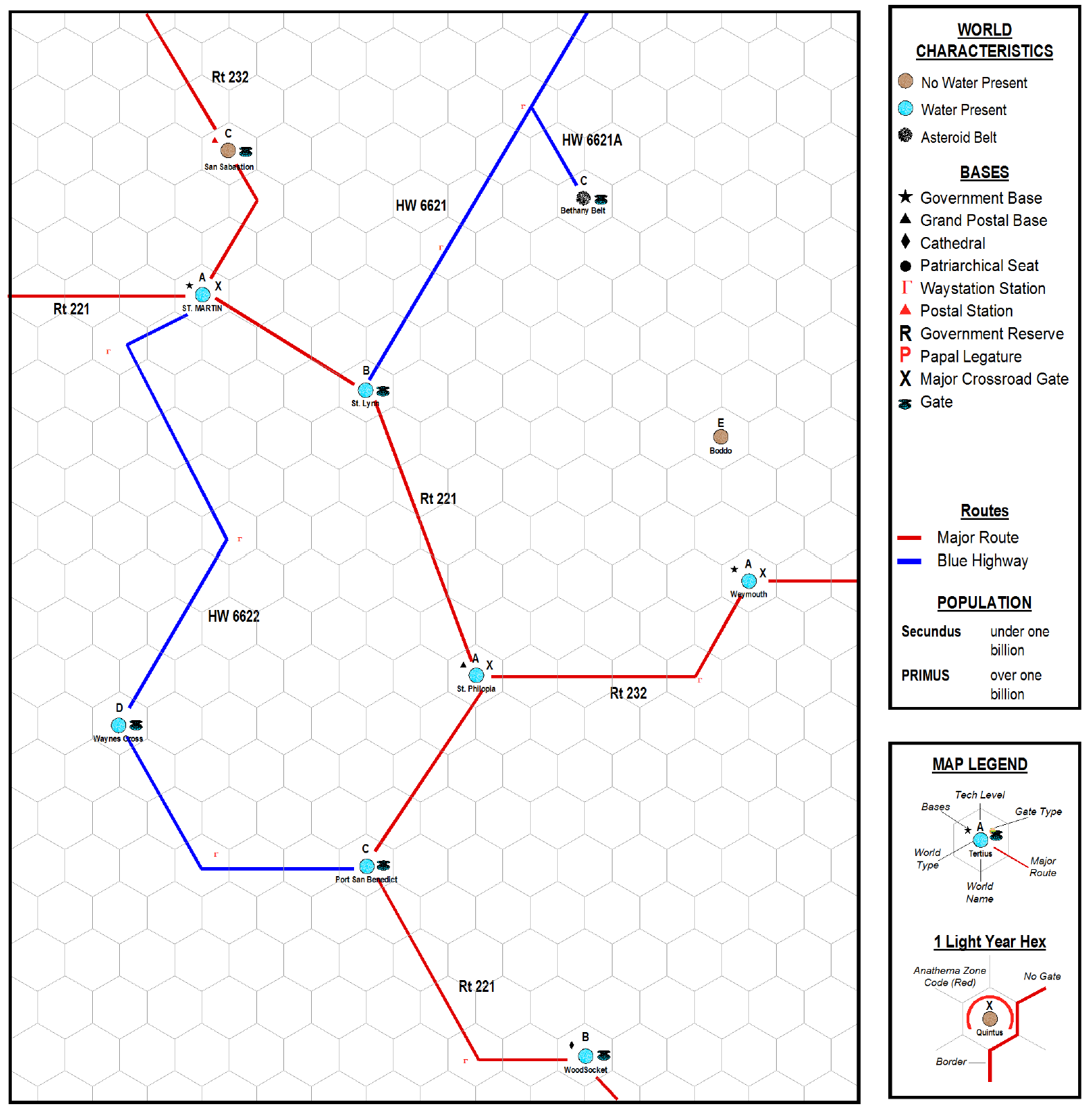
On the game map worlds are placed on a field of hexes. Each hex is 1 light year of subspace travel across (times the subspace quality factor.) Planets are represented as either having no water present, which typically means they have not been terraformed and have hostile environments, having water present, in which case they either have natural human compatible environments or have been terraformed, or are asteroid belts, meaning the system has no major planets. The tech level of the system is designated above the planet. To the left base designations are given. To the right whether the world is a major crossroads or even just has a gate portal. Red lines illustrate the Major Routes and blue lines the Blue Highways. In the Midlands and Wilds a red line along the hexes is used to illustrate borders. Worlds which have been placed under Church Interdiction are noted with a red arc.
Waystations are basically network road truck stops. Fusion powered B/G engine powered spacecraft don't need to stop for fuel, but the human occupants do need to stretch their legs, get grub and buy little bobble headed dolls so superstructure has been constructed around some beacon stations to allow spacecraft passengers a place to rest.
On maps routes are often shown as having doglegs. This is to make them conform to the travel distance between worlds. The convention is to lay out routes so that Waystations are located at the angles of the doglegs.
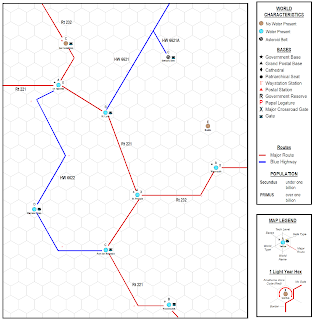 The map above is of St. Martin Diocese, located in County Cook in the Highlands. There is a Highland Rangers station at St. Martin. The cathedral is located at WoodSocket due to the shrine of Our Lady of WoodSocket being located on that world. There is a Syro-Malabar Catholic Cathedral at St. Martin. Waystations are typically named and numbered based on the route they are on. So the Rt 232 Waystation between St. Philopia and Wymouth is 232-15.
On the game map worlds are placed on a field of hexes. Each hex is 1 light year of subspace travel across (times the subspace quality factor.) Planets are represented as either having no water present, which typically means they have not been terraformed and have hostile environments, having water present, in which case they either have natural human compatible environments or have been terraformed, or are asteroid belts, meaning the system has no major planets. The tech level of the system is designated above the planet. To the left base designations are given. To the right whether the world is a major crossroads or even just has a gate portal. Red lines illustrate the Major Routes and blue lines the Blue Highways. In the Midlands and Wilds a red line along the hexes is used to illustrate borders. Worlds which have been placed under Church Interdiction are noted with a red arc.
Waystations are basically network road truck stops. Fusion powered B/G engine powered spacecraft don't need to stop for fuel, but the human occupants do need to stretch their legs, get grub and buy little bobble headed dolls so superstructure has been constructed around some beacon stations to allow spacecraft passengers a place to rest.
On maps routes are often shown as having doglegs. This is to make them conform to the travel distance between worlds. The convention is to lay out routes so that Waystations are located at the angles of the doglegs.
Tuesday, January 18, 2011
The Barnes-Gutierrez Hyperspace Engine
The Barnes-Gutierrez Hyperspace Engine is an engine which can function in two operational modes, depending upon how it is configured. In its standard mode it acts as a gravity drive. That is it is capable of directly transferring energy into thrust. B/G Engines in gravity drive mode can be built quite small, small enough to power bullets. In its hypershunt mode it is capable of shunting a specific amount of mass into subspace. While in hyperspace the relative faster than light speed of a B/G equipped ship is 1 light year per hour irregardless of the amount of mass the engine has shunted into subspace, times the subspace quality factor, modified by the Navigation Skill Modifier. The first factor is a function of the existing subspace superstructure. These Quality factors are:
The Navigation Skill Modifier runs from +3 to .5. IN GURPS terms a +3 is a critical success and a .5 is a Critical failure. A success gives a +2. Using an automatic pilot results in a modification factor of 1. Trip modifiers are typically calculated for journey legs between subspace gates or between worlds when there is no route, even if the world is not a waypoint or destination.
It is possible to design a B/G engine without the ability to hypershunt, indeed B/G engines used by planetary craft and many ships which exclusively utilize the Hyperspace Routes do not need to shunt.
|
It is possible to design a B/G engine without the ability to hypershunt, indeed B/G engines used by planetary craft and many ships which exclusively utilize the Hyperspace Routes do not need to shunt.
For game design purposes I use a modified version of GURPS Space's Modular Starship Design System, which itself is based on GURPS Vehicle 2nd Edition rules.
The B/G drive is designed as a Gravity Drive at Tech Level 12. If it has shunting capability the engine's weight will be 10 lbs per ton of shunting capacity plus the weight of the reactionless drive unit. Volume will be weight/50 cf for the shunting unit plus the volume of the gravity drive unit. Power requirement is the power requirement of the gravity drive. It cannot use its gravity drive and shunt mass into subspace at the same time. For GURPS purposes weight is equivalent to mass at 1G.
Subspace quality factor is a measure of the best case average speed of a vehicle in subspace. It is possible for local conditions in subspace to modify these numbers. Major Routes are designed to circumvent negative local conditions as much as possible but subspace storms sometimes still disrupt travel on the Major Routes. It is also possible for badly maintained hyperspacial drills to damage subspace topology, resulting in delays. Along less traveled roads or where there are no roads at all ships are sometimes required to re-route or even leave subspace to get their bearings resulting in reduced effective quality factors for long distance travel.
Subspace
Subspace is the theoretical mathematical construct used to describe the extra-non-euclidean time-space structure upon which the framework of normal space is built.
In order to explain subspace to laymen without the use of tensors, manifolds and eigenvectors, physicists typically describe subspace as a two dimensional plane in a three dimensional space. Large mass bodies in normal space translate as plateaus in subspace. The larger and more massive the body the higher and larger the plateau. The faces of the plateaus form a massive shear plane easily capable of ripping apart any object which attempts to traverse them. The only safe place is on the surface of subspace which corresponds to the space between worlds and on the plateaus.
These gravitational shear planes extend out from any object in real space. That is a stellar or planetary body will create an area in real space in which it is dangerous to try a shunt into subspace. As a rule of thumb this area extends for a volume approximately 100 diameters around the body. Any vessel shunting into subspace in this volume will be torn apart by the shear plane caused by the body. It takes a mass equivalent to a small planet, or very large asteroid to produce a large enough shear to create this effect.
The surface of subspace changes as a function of the density of stars or other matter in real space. Where stellar density is high travel is faster and easier. Where it is low, such as between the stellar arms or at the edge of the galaxy it is slow and difficult.
Normal matter can exists in subspace in the same way that it exists in real space. To an observer in subspace it appears as though one is immersed in a glowing cloud of color. The shear plane of gravitational plateaus appear as rugged discontinuities. Other normal space objects, such as other ships, beacons and portal gates appear normally, though speed and distance don't always seem to correlate properly to the human mind.
As might be expected there is no air in subspace. Research has shown that, while sensory input from looking too long as some subspace topological structures, such as shear planes, can cause headaches, generally observing subspace results in no adverse physiological or psychological effects.
Subspace Ghosts are unexplained objects and sometimes people which have been reported by observers. Many times such objects are merely ships of unknown or unusual designs. Sometimes such objects do not appear to be solid and some physicists have postulated they are the reflections of objects located in real space or in a hyperspace separate from subspace. Some believe they are either the souls of the damn or angelic messengers, although the Church has been silent on the matter.
Topological features in subspace are not always stable. Gravity producing masses in real space move in their relation to each other and sometime this causes shifts in the underlying topology of subspace. Such topological shifts are called subspace storms, and they can be very destructive as shear planes move through subspace causing havoc to objects from normal space.
In order to explain subspace to laymen without the use of tensors, manifolds and eigenvectors, physicists typically describe subspace as a two dimensional plane in a three dimensional space. Large mass bodies in normal space translate as plateaus in subspace. The larger and more massive the body the higher and larger the plateau. The faces of the plateaus form a massive shear plane easily capable of ripping apart any object which attempts to traverse them. The only safe place is on the surface of subspace which corresponds to the space between worlds and on the plateaus.
These gravitational shear planes extend out from any object in real space. That is a stellar or planetary body will create an area in real space in which it is dangerous to try a shunt into subspace. As a rule of thumb this area extends for a volume approximately 100 diameters around the body. Any vessel shunting into subspace in this volume will be torn apart by the shear plane caused by the body. It takes a mass equivalent to a small planet, or very large asteroid to produce a large enough shear to create this effect.
The surface of subspace changes as a function of the density of stars or other matter in real space. Where stellar density is high travel is faster and easier. Where it is low, such as between the stellar arms or at the edge of the galaxy it is slow and difficult.
Normal matter can exists in subspace in the same way that it exists in real space. To an observer in subspace it appears as though one is immersed in a glowing cloud of color. The shear plane of gravitational plateaus appear as rugged discontinuities. Other normal space objects, such as other ships, beacons and portal gates appear normally, though speed and distance don't always seem to correlate properly to the human mind.
As might be expected there is no air in subspace. Research has shown that, while sensory input from looking too long as some subspace topological structures, such as shear planes, can cause headaches, generally observing subspace results in no adverse physiological or psychological effects.
Subspace Ghosts are unexplained objects and sometimes people which have been reported by observers. Many times such objects are merely ships of unknown or unusual designs. Sometimes such objects do not appear to be solid and some physicists have postulated they are the reflections of objects located in real space or in a hyperspace separate from subspace. Some believe they are either the souls of the damn or angelic messengers, although the Church has been silent on the matter.
Topological features in subspace are not always stable. Gravity producing masses in real space move in their relation to each other and sometime this causes shifts in the underlying topology of subspace. Such topological shifts are called subspace storms, and they can be very destructive as shear planes move through subspace causing havoc to objects from normal space.
Subscribe to:
Posts (Atom)