The Highland Department of Roads maintains the system of gates, beacon stations, and waystations along the Major Routes in subspace. They also operate the hyperdrills that stabilize subspace and make possible the placement of gates in planetary orbit. Workers of the department are called roadies.
Along with members of the Grand Postal Service roadies also maintain and operate the hypercable system. They work with the posties in ensuring messages are delivered once they have exited the hypercable system for delivery to systems not connected.
As might be expected with such a wide range of responsibilities there is no typical roadie.
Within the Grand Human Union the department maintains huge traveling road camps in subspace, typically built on large 500,000-1,500,000 cuft ship platforms which contain quarters, workshops and hangars for hyperdrills, mining craft and other supporting vehicles.
Subspace contains no natural occurring bodies to provide construction material so road camps typically ferry raw materials from asteroid belts and gas giants in handy systems in normal space into subspace to provide stock for the huge industrial nanofactory fabricators located in the road camp workshops and for the portable fabricator machines used to construct the gates, beacon stations and waystation frames. Much of the interior of these structures are constructed by follow on contractors.
Typically thousands of workers support the typical road camp and the camp supports dependents as well. Many couples work the road camps and spend most of their lives traveling along the roads.
Operating roads still require a cadre of specialist technicians to support the repair robots which maintain the beacon stations. Some live at one of the waystations and travel down their route in brakes or HUVs configured as repair vehicles, returning to family after a few days on the road seeing to their charges.
Others are under the care of technician couples working from saucer shaped ketches, 15,000-50,000 cuft vessels containing living spaces, workshops and stock storage holds, most commonly staffed by extended family. In many ways this class of roadies most closely resembles the lighthouse keepers of maritime days, living in relative isolation as they move down the road of their section, maintaining beacon stations, picking up repair stock at roadie depots on the waystations and repairing hypercable installations.
Another responsibility of the Department of Roads is the DOR stormwatch channel. Stormwatch sensors located in beacon stations transmit gravametric information to weather centers located at certain waystations in each road section. The weather stations analyze the information and post storm warnings to be broadcast from the beacon stations to local traffic on the DOR stormwatch channel.
Keeping the stormwatch sensors operating is a part of the job of the maintenance road crews. Most of the storm analysis on the establish network is done by AI, but on new roads or ones still under construction people still have to aid in storm detection.
Showing posts with label Political. Show all posts
Showing posts with label Political. Show all posts
Monday, August 21, 2017


Thursday, November 24, 2011
Village of Santa Monica
The Village of Santa Monica is a typical Highland population center. Located on the Blue Highway world Cecilia's Promise, Santa Monica is named after the mother of Saint Augustine because the settlers claimed waters of the bay to be "as clear as the tears of Saint Monica as she prayed for the salvation of her son, Augustine."
Like many such habitats the center of the village is the parish church, the Church of Saint Monica. With a population of about fourteen hundred, the Village of Santa Monica is about standard size for a population center on Cecilia's Promise. This does not include the nearby agricultural residences, which make up a separate dispersed settlement.
The architectural style of Santa Monica is post-nano modern. Like all villages the town is a collection of individual residences, commercial structures and official buildings. Official structures, besides the parish church, include the Parish Seat, that is the local government center, the Grand Post Office, and the Transmat Portal.
Official Structures
Parish Seat
The Parish Seat is a two story structure which includes the the office of the village council, the constable's office and the central repository, the local mirror of Cecilia's Promise inter-web.
Grand Post Office
The Grand Post Office is the local branch of the Highland spanning system. In the case of Santa Monica the office itself is attached to Params Deliveries and General Fabrications. The local Postie position is part time, and occupied by the proprietor of that establishment. Message traffic is downloaded vie satellite and package goods delivered via the transmat portal, which is also under the administrative control of Mistress Param, owner of said establishment.
Transmat Portal
Santa Monica's transmat portal is a standard mix use permanent portal. Mixed use means that it is designed to be used by both pedestrians and cargo. Permanent means that it is commonly maintained in an open state, that is both portal openings are more-or-less fixed in their connected state. Dry goods and drums are translated through the portal using transport sleds. The farside of the portal is located in Ellisa, a small port city near the planetary capital.
Commercial Establishments
Params Deliveries and General Fabrications
Commercial buildings are dominated by Params Deliveries and General Fabrications, which has one of the village's commercial nanotech factories. Hettie Param is the local Postie and also handles commercial package mail. Much of the small industrial raw material importing, used to support home and small commercial nanotech fabrication comes through Params. The General Fabrications portion of the establishment tends to concentrate on the making of low to medium tech quick fabs, which require fairly simple design specs and a limited number of stock materials.
Moranti Livery
The village itself is small enough that every structure is within walking distance, indeed this is one of the criteria that distinguishes a village from a larger entity, such as a town, which may have some form of public transportation network, either transmat or vehicular. However residence do sometimes need to travel to the surrounding agricultural homesteads or desire to visit local wildlands. The irregular nature of such activities makes the personal ownership of transport capsules economically wasteful. Moranti's has capsules for rent at reasonable rates for a multitude of uses. Some are small enough to use the transmat portal, others are large enough to use for general hauling. Autopilot capsules act as taxi's and delivery vehicles.
The Clay Jar Pub
For nearly all of human history there has existed establishments where people could buy meals and enjoy a sociable drink. In many places such businesses become community hubs. The Clay Jar pulls in business from the surrounding agriculture community as well as from Santa Monica.
Wing's Inn
Primarily an eating establishment Hosea Wing's hostel also has a dozen or so bedrooms which can accommodate village visitors. The Inn has two semi-regular residents, but most of the other rooms are typically available for travelers. Breakfast is typically included in the price of a room.
Broadline Fabrications
A general purpose technology fabrication facility, Broadline provides the main local source for nanofactory produced items, which are typically made to order from their extensive design catalog. The dozen or so employees include two design engineers who can spot design items or turn external designs into product at a modest cost. Their large nanofactory machines also provide the main fabrication facilities for the surrounding agricultural community.
Greengold's Market
Primarily an outlet for local agricultural products, such as dairy and meat, Greengold's also carries a small number of processed food items. Most residents travel to Ellisa regularly to get larger quantities of drygoods and stock food items.
Church of Saint Monica
The Parish Church complex includes the church itself, the associated rectory, the residence of pastor Fr. Martin Wolf, St. Augustine Hall, the parish's fellowship building and the parish school. The parochial school serves approximately 800 students.
Like many such habitats the center of the village is the parish church, the Church of Saint Monica. With a population of about fourteen hundred, the Village of Santa Monica is about standard size for a population center on Cecilia's Promise. This does not include the nearby agricultural residences, which make up a separate dispersed settlement.
The architectural style of Santa Monica is post-nano modern. Like all villages the town is a collection of individual residences, commercial structures and official buildings. Official structures, besides the parish church, include the Parish Seat, that is the local government center, the Grand Post Office, and the Transmat Portal.
Official Structures
Parish Seat
The Parish Seat is a two story structure which includes the the office of the village council, the constable's office and the central repository, the local mirror of Cecilia's Promise inter-web.
Grand Post Office
The Grand Post Office is the local branch of the Highland spanning system. In the case of Santa Monica the office itself is attached to Params Deliveries and General Fabrications. The local Postie position is part time, and occupied by the proprietor of that establishment. Message traffic is downloaded vie satellite and package goods delivered via the transmat portal, which is also under the administrative control of Mistress Param, owner of said establishment.
Transmat Portal
Santa Monica's transmat portal is a standard mix use permanent portal. Mixed use means that it is designed to be used by both pedestrians and cargo. Permanent means that it is commonly maintained in an open state, that is both portal openings are more-or-less fixed in their connected state. Dry goods and drums are translated through the portal using transport sleds. The farside of the portal is located in Ellisa, a small port city near the planetary capital.
Commercial Establishments
Params Deliveries and General Fabrications
Commercial buildings are dominated by Params Deliveries and General Fabrications, which has one of the village's commercial nanotech factories. Hettie Param is the local Postie and also handles commercial package mail. Much of the small industrial raw material importing, used to support home and small commercial nanotech fabrication comes through Params. The General Fabrications portion of the establishment tends to concentrate on the making of low to medium tech quick fabs, which require fairly simple design specs and a limited number of stock materials.
Moranti Livery
The village itself is small enough that every structure is within walking distance, indeed this is one of the criteria that distinguishes a village from a larger entity, such as a town, which may have some form of public transportation network, either transmat or vehicular. However residence do sometimes need to travel to the surrounding agricultural homesteads or desire to visit local wildlands. The irregular nature of such activities makes the personal ownership of transport capsules economically wasteful. Moranti's has capsules for rent at reasonable rates for a multitude of uses. Some are small enough to use the transmat portal, others are large enough to use for general hauling. Autopilot capsules act as taxi's and delivery vehicles.
The Clay Jar Pub
For nearly all of human history there has existed establishments where people could buy meals and enjoy a sociable drink. In many places such businesses become community hubs. The Clay Jar pulls in business from the surrounding agriculture community as well as from Santa Monica.
Wing's Inn
Primarily an eating establishment Hosea Wing's hostel also has a dozen or so bedrooms which can accommodate village visitors. The Inn has two semi-regular residents, but most of the other rooms are typically available for travelers. Breakfast is typically included in the price of a room.
Broadline Fabrications
A general purpose technology fabrication facility, Broadline provides the main local source for nanofactory produced items, which are typically made to order from their extensive design catalog. The dozen or so employees include two design engineers who can spot design items or turn external designs into product at a modest cost. Their large nanofactory machines also provide the main fabrication facilities for the surrounding agricultural community.
Greengold's Market
Primarily an outlet for local agricultural products, such as dairy and meat, Greengold's also carries a small number of processed food items. Most residents travel to Ellisa regularly to get larger quantities of drygoods and stock food items.
Church of Saint Monica
The Parish Church complex includes the church itself, the associated rectory, the residence of pastor Fr. Martin Wolf, St. Augustine Hall, the parish's fellowship building and the parish school. The parochial school serves approximately 800 students.
Saturday, October 22, 2011
Urban Life
The span of history of the New Diasporia actually ranges just over a century. Most of the great social trends originate from before that period. By the time of Fr. Borland Barnes and Joesph Gutierrez a Unified Catholic Church was already in existence. The Great Compromise was in place. In many ways the first wave of the New Diasporia was made up of people who had problems with both those facts of history. Only more slowly did the Church and society follow in successive waves.
The just of those facts means that throughout all extra solar space human civilization is barely a century old. For almost all of that time travel was limited to conventional road and air vehicles. Even in the farthest reaches of the Wilds civilization, or what passes for it, is just a generation or two old. In the oldest and most primitive places perhaps as many as six generations have passed since the invention of the B/G engine.
This tends to mean that on any particular world history is not too deep. On Earth it is not unusual to see structures several hundred years old. It is even possible to see man made structures thousands of years old. This is not the case on other worlds.
Because of the pace of technological development and the speed of transport cities tend to be smaller than the old Earth cities. Most terrestrial cities are old. They formed at transportation hubs, which is why so many cities were founded where rivers meet each other, or meet the sea. In the age of rail cities were founded at rail heads and junctions. Even in the pre-industrial age cities sometimes were built at places where gold, silver and iron could be found. Only in the age of the automobile did population centers swell over the land, tied together by concrete and asphalt ribbons.
In the Highland cities, towns and villages, founded before the mid-twenty third century, it is common to have roads and highways connecting buildings and other population centers. On many worlds these artifacts of an earlier age are abandoned and unused. At least by human traffic. Interior roads are still sometimes used to transport goods using autonomous robot vehicles. On others settled during the last seventy years often commercial transmat portals are still in use, connecting roads or monorails over vast distances. Some settled recently have no roads at all, with all transportation via transmat portal.
A matrix may be used to help determine the probable mixture of transportation technologies. Many of the other cultural and social characteristics of the world can be inferred from the combination of when the world was founded and what is it's present Tech Level.
Any Highland world founded after 2300 A.D. and founded at TLA will lack roads. Transmat portals will provide the primary transportation technology. Cities will be small and widely dispersed, perhaps even over several continents. A city, village or town is really more a designation of jurisdiction than of geographical area, since the shopping district can be in one place, the residential district in another place and facilities for space traffic somewhere else. Cities are differentiated from villages in that a village will have shopping, residential areas, churches and perhaps even a monastery all within walking distance, with transmat portals primarily used to travel to other places. Such population centers are not primarily vehicle friendly (since vehicles are seldom if ever used) and walkways and pathways are laid out with aesthetic and architectural considerations in mind rather than vehicular. If transportation is need to areas not served by transmat transport capsules will be used.These worlds are represented by the dark blue area of the graph.
The just of those facts means that throughout all extra solar space human civilization is barely a century old. For almost all of that time travel was limited to conventional road and air vehicles. Even in the farthest reaches of the Wilds civilization, or what passes for it, is just a generation or two old. In the oldest and most primitive places perhaps as many as six generations have passed since the invention of the B/G engine.
This tends to mean that on any particular world history is not too deep. On Earth it is not unusual to see structures several hundred years old. It is even possible to see man made structures thousands of years old. This is not the case on other worlds.
Because of the pace of technological development and the speed of transport cities tend to be smaller than the old Earth cities. Most terrestrial cities are old. They formed at transportation hubs, which is why so many cities were founded where rivers meet each other, or meet the sea. In the age of rail cities were founded at rail heads and junctions. Even in the pre-industrial age cities sometimes were built at places where gold, silver and iron could be found. Only in the age of the automobile did population centers swell over the land, tied together by concrete and asphalt ribbons.
In the Highland cities, towns and villages, founded before the mid-twenty third century, it is common to have roads and highways connecting buildings and other population centers. On many worlds these artifacts of an earlier age are abandoned and unused. At least by human traffic. Interior roads are still sometimes used to transport goods using autonomous robot vehicles. On others settled during the last seventy years often commercial transmat portals are still in use, connecting roads or monorails over vast distances. Some settled recently have no roads at all, with all transportation via transmat portal.
A matrix may be used to help determine the probable mixture of transportation technologies. Many of the other cultural and social characteristics of the world can be inferred from the combination of when the world was founded and what is it's present Tech Level.
| Present Technology Level | A | B | C | D | |
| Founding Year | |||||
| 2320 | |||||
| 2310 | |||||
| 2300 | Nanotech | ||||
| 2290 | |||||
| 2280 | |||||
| 2270 | |||||
| 2260 | Transmat | ||||
| 2250 | |||||
| 2240 | |||||
| 2230 | Hyperdrill | ||||
| 2220 | |||||
| 2210 | B/G Engine |
Any world founded before 2300 A.D. but after 2260 A.D. and founded at TL A or B will have some form of road network. If they are still TL B they will have a mixture of commercial transmat portals and vehicle lines. Transmat assisted monorail and roadways allow trans continental and trans world travel using public trains or private road vehicles. Air travel will be relegated to orbital or extra-planetary transport. If they have advanced to TL A it is likely they will have abandoned roads. Streets will be relegated to older, economically depressed areas. New villages and towns will resemble those seen on worlds in the dark blue area of the graph. These worlds are in the medium blue area of the graph.
Any world founded before 2260 A.D. after 2210 A.D. will have as extensive a road network as would be required without transmat technology. Any population center which pre-dates the mid twenty-third century will have extensive road or rail or public transportation systems. If the world has advanced to TL B some of these systems, especially those between population centers will have been replaced with commercial transmat portals. If they have advanced to TL A whole population centers with their road systems may have been abandon in favor of more advanced, nanotech produced, villages and cities supported by transmat technology. Those areas not abandoned may be occupied by the economically disadvantaged or they may have been upgraded, with their street re-purposed as tracks or walkway or built upon as newly reclaimed land.
Worlds still at tech levels below B will still use their roads and public transportation systems. Gravity assisted ground vehicles and transport capsules will make up the majority of transport. Newer materials might be used for roads, and it is possible that planned communities could exist which separate vehicles from pedestrians. With lots of land and relatively few people the overcrowding existing in many areas of Earth is seen less, at least in the Highlands.
Outside the Highlands a much greater variety of technology mix and social and cultural geography is possible.
Thursday, October 20, 2011
Life in a distributist nanotech society
The most difficult aspect of adventuring in any society whose tenants are radically different from the players own is trying to imagine what life is like for the player characters. This is important because social norms color what kinds of choices are reasonable for the characters to make and so limit the options of the players. These limitations are most often enforced by the referee or storyteller or gamemaster, but automatic compliance of the players often is effected by how reasonable those limits seem.
Very few players would disagree with a GM who called a SWAT team in if their characters shoot up a police station. Their response might be different if the GM calls in a ninja hit squad because they've ambushed a Confederate scouting party in a U.S. Civil War era game.
So social environment is very important. If the society is radically different, say a devout Christian norm as opposed to the radical progressive secularism of the present day that still might not be that great a leap. The PCs could likely look back several hundred years to the societal norm of the pre-Reformation Christian eras. However such societies were very different from civilization in the Highlands, most notably due to the existence of nantechnology.
Now the limitations of nanotechnology quite put to rest the common fantasy of a nanite swarm creating a banquet complete with table, chairs, prime rib, and champagne cooling in its ice bucket out of thin air. Even so it is easy to see that a small group outfitted with a number of nanotech factories and the designs needed to utilize them would be quite independent of need for the economic structures typically organized along traditional capitalistic grounds.
While the economic structure practiced within the Highlands might be categorized as distributism, it is no more pure pure distributism than what is practiced in the twenty-first century United States is pure capitalism or what is practiced in twenty-first century China is communism or capitalism.
The very existence of nanotechnology makes old supply side economics obsolete. But even when anyone with a nanotech factory and a pile of materials can make just about anything there is still an advantage to a certain amount of specialization. Someone still has to design the patterns that factories use to create items. Metals, petrochemicals and other elements must still be mined, purified and transported. And even with nanotech factories it is still more efficient to grow a crop or raise a herd than it is to produce nano-tech food.
Some amount of capitalization, that is the concentration of capital for the purposes of investment still occurs. The difference being the lack of isolation from consequences which was inherent in the progressive era corporate system.
Corporations, as originally instituted, limited the liability of investors for debt beyond the amount of assets they had in the corporation. This shifted risk to the debtors of the corporation. In the 19th century this was extended to protect shareholders by limiting the corporation's liability in both contract and tort claims. This further isolated members of the corporation from accountability for the corporation's actions. In the 20th century, changing law served to concentrate authority for guidance of corporate actions in the hands of corporate managers, who were theoretically accountable to shareholders, but often beyond their actual control. This further isolated those controlling the actions of the corporation from the consequences of their actions, both moral and legal. Of course it was possible for governments to hold corporate officers accountable for illegal activities, and even for a corporation to be dissolved for a pattern of such activities. Such sanctions typically require extensive and expensive action on the part of government, with corporate officers often shielded from direct accountability and hapless shareholders punished through loss of asset value. This pertains to legal responsibility, attempting to hold corporations up to moral accountability was even harder. This ignored the inevitable corruptive effect exercised by many large corporations as they solicited beneficial laws from compliant political leaders in return for both legal and illegal bribery.
Like many types of destructive social patterns the initial consequence of the decoupling of cause and effect resulted in a temporary economic boom. Often such patterns extend for what in human terms is a significant span of time, making the inevitable consequences less obvious. But the cause and effect relationship is as true as the law of gravity. The consequences of the divorce of behavior consequences in the economic sphere would eventually lead to economic collapse.
As communism and socialism fail because they do not take into account the nature of man so to does capitalism fail when it too fails to take into account the concupiscence caused by original sin.
Adam Smith's "invisible hand" does not work when the natural balance of economic cause and effect is corrupted by government intervention, legal redirection of consequences or criminal intent. Corporations and capitalism on their own are neither morally corrupt or sinful. However in their original incarnation, that is chartered by governments, for the common good, rather than to realize corporate revenues for the state in the form of taxes or profits for the shareholders, corporations can produce enormous good and still produce profit, which is of itself not sinful. This is accomplished by keeping corporations closely regulated, focusing on the protection of the public good and limiting corporations to comply with the purposes expressed in their charters. This generally results in small corporations, which are closely regulated by government in the interest of the commons. Naturally this produces a lower rate of return than unfettered capitalism, but it also prohibits the fiction of the immortal corporate "person", beyond common morals and ethical constraints. It also tends to ensure profits over the long run, if limiting their unfettered expansion. In the Highlands this is considered an equitable trade.
Very few players would disagree with a GM who called a SWAT team in if their characters shoot up a police station. Their response might be different if the GM calls in a ninja hit squad because they've ambushed a Confederate scouting party in a U.S. Civil War era game.
So social environment is very important. If the society is radically different, say a devout Christian norm as opposed to the radical progressive secularism of the present day that still might not be that great a leap. The PCs could likely look back several hundred years to the societal norm of the pre-Reformation Christian eras. However such societies were very different from civilization in the Highlands, most notably due to the existence of nantechnology.
Now the limitations of nanotechnology quite put to rest the common fantasy of a nanite swarm creating a banquet complete with table, chairs, prime rib, and champagne cooling in its ice bucket out of thin air. Even so it is easy to see that a small group outfitted with a number of nanotech factories and the designs needed to utilize them would be quite independent of need for the economic structures typically organized along traditional capitalistic grounds.
While the economic structure practiced within the Highlands might be categorized as distributism, it is no more pure pure distributism than what is practiced in the twenty-first century United States is pure capitalism or what is practiced in twenty-first century China is communism or capitalism.
The very existence of nanotechnology makes old supply side economics obsolete. But even when anyone with a nanotech factory and a pile of materials can make just about anything there is still an advantage to a certain amount of specialization. Someone still has to design the patterns that factories use to create items. Metals, petrochemicals and other elements must still be mined, purified and transported. And even with nanotech factories it is still more efficient to grow a crop or raise a herd than it is to produce nano-tech food.
Some amount of capitalization, that is the concentration of capital for the purposes of investment still occurs. The difference being the lack of isolation from consequences which was inherent in the progressive era corporate system.
Corporations, as originally instituted, limited the liability of investors for debt beyond the amount of assets they had in the corporation. This shifted risk to the debtors of the corporation. In the 19th century this was extended to protect shareholders by limiting the corporation's liability in both contract and tort claims. This further isolated members of the corporation from accountability for the corporation's actions. In the 20th century, changing law served to concentrate authority for guidance of corporate actions in the hands of corporate managers, who were theoretically accountable to shareholders, but often beyond their actual control. This further isolated those controlling the actions of the corporation from the consequences of their actions, both moral and legal. Of course it was possible for governments to hold corporate officers accountable for illegal activities, and even for a corporation to be dissolved for a pattern of such activities. Such sanctions typically require extensive and expensive action on the part of government, with corporate officers often shielded from direct accountability and hapless shareholders punished through loss of asset value. This pertains to legal responsibility, attempting to hold corporations up to moral accountability was even harder. This ignored the inevitable corruptive effect exercised by many large corporations as they solicited beneficial laws from compliant political leaders in return for both legal and illegal bribery.
Like many types of destructive social patterns the initial consequence of the decoupling of cause and effect resulted in a temporary economic boom. Often such patterns extend for what in human terms is a significant span of time, making the inevitable consequences less obvious. But the cause and effect relationship is as true as the law of gravity. The consequences of the divorce of behavior consequences in the economic sphere would eventually lead to economic collapse.
As communism and socialism fail because they do not take into account the nature of man so to does capitalism fail when it too fails to take into account the concupiscence caused by original sin.
Adam Smith's "invisible hand" does not work when the natural balance of economic cause and effect is corrupted by government intervention, legal redirection of consequences or criminal intent. Corporations and capitalism on their own are neither morally corrupt or sinful. However in their original incarnation, that is chartered by governments, for the common good, rather than to realize corporate revenues for the state in the form of taxes or profits for the shareholders, corporations can produce enormous good and still produce profit, which is of itself not sinful. This is accomplished by keeping corporations closely regulated, focusing on the protection of the public good and limiting corporations to comply with the purposes expressed in their charters. This generally results in small corporations, which are closely regulated by government in the interest of the commons. Naturally this produces a lower rate of return than unfettered capitalism, but it also prohibits the fiction of the immortal corporate "person", beyond common morals and ethical constraints. It also tends to ensure profits over the long run, if limiting their unfettered expansion. In the Highlands this is considered an equitable trade.
Wednesday, June 22, 2011
Barbarians at the gates
It might seem reasonable that, in the Midlands at least, a world or group of worlds might arise to challenge the Grand Human Union's hegemony. After all domination has always been a strong characteristic of human interaction. Strength is often the determining factor of history rather than morality.
The propagation of superior technology from the Highland's center to its edges have resulted in a practical dominance of the Union of the worlds along its borders. They tend to be highly dependent on the Highlands and incorporation quickly becomes a foregone conclusion.
Most experts known that eventually a large enough group of worlds outside the Highlands will become organized enough and be stubborn enough to resist absorption, but this has not happened yet, and there are no polities within a hundred light years of the border organized enough or large enough to realistically worry about. Farther than that worlds tend to lag technologically behind the Highlands, so even a fairly large grouping of worlds are not really considered a threat, at least not to the Union.
These world groups are themselves sometimes targets of their less enlightened neighbors. The Union, and its Star Legion seldom take part in these conflicts, but their have been exceptions. The militant orders are more likely to take a stand, especially if the Church is threatened by these disagreements.
The propagation of superior technology from the Highland's center to its edges have resulted in a practical dominance of the Union of the worlds along its borders. They tend to be highly dependent on the Highlands and incorporation quickly becomes a foregone conclusion.
Most experts known that eventually a large enough group of worlds outside the Highlands will become organized enough and be stubborn enough to resist absorption, but this has not happened yet, and there are no polities within a hundred light years of the border organized enough or large enough to realistically worry about. Farther than that worlds tend to lag technologically behind the Highlands, so even a fairly large grouping of worlds are not really considered a threat, at least not to the Union.
These world groups are themselves sometimes targets of their less enlightened neighbors. The Union, and its Star Legion seldom take part in these conflicts, but their have been exceptions. The militant orders are more likely to take a stand, especially if the Church is threatened by these disagreements.
Monday, May 30, 2011
The Grand Postal Service.
The Grand Postal Service is responsible for delivering mail within the borders of the Highlands. Along the Major Routes message traffic is sent through the hypercable communication system. The Postal Service primarily delivers packages along the Major Routes. A very small amount of express mail document delivery is done by the Postal Service to worlds on Major Routes, primarily special government and Church documents.
Postal routes join together worlds on the Blue Highways and worlds off the road network entirely. Much of this traffic travels on Postal Couriers, tractors which tow a postal module. Modules come in several varieties. Most consists of a cargo area for packages and a bank of computer storage for electronic traffic. Once the courier arrives in system it will broadcast its electronic message traffic to the local system communication network. Traffic which is for systems farther down the postal route is transmitted to another courier. Packages are transfered at the portal gate along Blue Highways or to orbital stations most other places. On a few worlds mail is actually delivered to the planetary starport.
At the borders postal routes sometime connect with external package services. A greater amount of non-electronic physical mail is also delivered to external partners. Such mail often is actually digital in nature, but delivered on physical media, both for greater security and to prevent data degradation.
Employees of the Grand Postal Service are known as Posties. The actual duties of the postie varies considerably depending upon where in the postal system the worker is assigned. Postal Couriers on Major Routes tend to travel repetative routes which have them on the road for two to three weeks on a circular route, with a week off at their home. Blue Highway couriers tend to spend more time on the road, often running down the road for months before taking significant time off at home. Off road postal couriers often deliver to a single off road world spending only a week or so in space and then returning. Some few spend almost all their time in larger schooner vessels traveling to a string of of road destinations. This is most common at the border regions.
Postal routes join together worlds on the Blue Highways and worlds off the road network entirely. Much of this traffic travels on Postal Couriers, tractors which tow a postal module. Modules come in several varieties. Most consists of a cargo area for packages and a bank of computer storage for electronic traffic. Once the courier arrives in system it will broadcast its electronic message traffic to the local system communication network. Traffic which is for systems farther down the postal route is transmitted to another courier. Packages are transfered at the portal gate along Blue Highways or to orbital stations most other places. On a few worlds mail is actually delivered to the planetary starport.
At the borders postal routes sometime connect with external package services. A greater amount of non-electronic physical mail is also delivered to external partners. Such mail often is actually digital in nature, but delivered on physical media, both for greater security and to prevent data degradation.
Employees of the Grand Postal Service are known as Posties. The actual duties of the postie varies considerably depending upon where in the postal system the worker is assigned. Postal Couriers on Major Routes tend to travel repetative routes which have them on the road for two to three weeks on a circular route, with a week off at their home. Blue Highway couriers tend to spend more time on the road, often running down the road for months before taking significant time off at home. Off road postal couriers often deliver to a single off road world spending only a week or so in space and then returning. Some few spend almost all their time in larger schooner vessels traveling to a string of of road destinations. This is most common at the border regions.
Tuesday, April 12, 2011
The Great Compromise
The Great Compromise is a symbol of both the imperfection of the temporal universe and the consequences of demographics on history. Some would also say it is an indication that a Pope's decisions outside the area of faith and morals are not infallible and might even be detrimental to the short term good of the Church. Others would point out that the Church should never impose but merely propose.
The Great Compromise is a legacy of the failings of the Progressive Era and the vast demographic shift of parts of Europe from Christian to Muslim. As secularism was squeezed out Sharia law became the predominate legal system for areas not traditionally Muslim. This did not sit well with all of the non-Muslim population, especially when coupled with the violence against Christians, Jews and non-believers that seemed to follow the Islamitization of most places.
This resulted in a long series of sectarian violence as Christians and secularist started taking reprisals for Muslim violence against non-Muslims in Islamic nations. For every church firebombed a Mosque was set ablaze. The Church spoke out against these actions, but was a lone voice as a combination of fear and survival instinct took over.
The remaining Secular/Christian nations, seeing the result of allowing Islamic groups to engineer demographic shifts through a pattern of emigration without absorption and eventual political manipulation responded by passing reciprocity laws. That is Muslim immigrants were prohibited from practising their faith publicly because Christians were prevented from public practice of their faith in nations under Sharia law.
Eventually The Christian East looked to the Pope as the one man in the Christian West who could speak for the Unifying Church. At Dover a group from what was left of the European Union, the Organization of American States and various non-aligned nations met with the Pan Islamic Union under the oversight of the Pope. Under much pressure from the national governments, the media and the Church the resulting treaty became the Great Compromise.
Under the Great Compromise the participants agreed that the reciprocity laws would be codified into international law. Christians would neither seek converts nor publicly worship in Islamic territories. Likewise Muslims would no longer be allowed to raise Mosques nor establish schools or attempt to convert in Christian territories. A policy of ethnic cleansing would for all intents and purposes be allow by which groups would be "induced" to emigrate out of their homes and into the respective sectarian territories.
As might be imagined many Christians saw this as a betrayal of the Great Commission placed upon the Church by Christ. The Church's position was that Christianity should not be imposed at the point of a spear and rational argument was not possible with a philosophy which rejected rational theological discourse. Time was on the side of the Church, it was argued, and the problem should be left in the hands of the Lord.
While the Compromised reduced, indeed almost eliminated the violence in the First World, Africa continued to be a battleground right up until the beginning of the twenty third century and the invention of the Barnes-Gutierrez Hyperspace Engine and the diaspora.
The Great Compromise is a legacy of the failings of the Progressive Era and the vast demographic shift of parts of Europe from Christian to Muslim. As secularism was squeezed out Sharia law became the predominate legal system for areas not traditionally Muslim. This did not sit well with all of the non-Muslim population, especially when coupled with the violence against Christians, Jews and non-believers that seemed to follow the Islamitization of most places.
This resulted in a long series of sectarian violence as Christians and secularist started taking reprisals for Muslim violence against non-Muslims in Islamic nations. For every church firebombed a Mosque was set ablaze. The Church spoke out against these actions, but was a lone voice as a combination of fear and survival instinct took over.
The remaining Secular/Christian nations, seeing the result of allowing Islamic groups to engineer demographic shifts through a pattern of emigration without absorption and eventual political manipulation responded by passing reciprocity laws. That is Muslim immigrants were prohibited from practising their faith publicly because Christians were prevented from public practice of their faith in nations under Sharia law.
Eventually The Christian East looked to the Pope as the one man in the Christian West who could speak for the Unifying Church. At Dover a group from what was left of the European Union, the Organization of American States and various non-aligned nations met with the Pan Islamic Union under the oversight of the Pope. Under much pressure from the national governments, the media and the Church the resulting treaty became the Great Compromise.
Under the Great Compromise the participants agreed that the reciprocity laws would be codified into international law. Christians would neither seek converts nor publicly worship in Islamic territories. Likewise Muslims would no longer be allowed to raise Mosques nor establish schools or attempt to convert in Christian territories. A policy of ethnic cleansing would for all intents and purposes be allow by which groups would be "induced" to emigrate out of their homes and into the respective sectarian territories.
As might be imagined many Christians saw this as a betrayal of the Great Commission placed upon the Church by Christ. The Church's position was that Christianity should not be imposed at the point of a spear and rational argument was not possible with a philosophy which rejected rational theological discourse. Time was on the side of the Church, it was argued, and the problem should be left in the hands of the Lord.
While the Compromised reduced, indeed almost eliminated the violence in the First World, Africa continued to be a battleground right up until the beginning of the twenty third century and the invention of the Barnes-Gutierrez Hyperspace Engine and the diaspora.
Monday, April 4, 2011
Wild Campaigning
Now it should not be a surprise that the farther one gets into the Wilds the more bizarre and disordered the indigenous civilizations tend to become.
People at the rim do not tend to come from the Highlands. They are not typically orthodox in their religious beliefs, nor are they well educated in Natural Law and the consequences of ignoring its conclusions. Many have fled to the rim precisely because the consequences of poor societal decisions have caught up with the places of their origin, be it economic collapse, sociological instability or moral confusion.
In many places the Church has attempted to re-inject sanity, holiness and rationality in to civilizations which have strayed from reality, often facing persecution, martyrdom and other dangers. Often societal disorder is accompanied by loss of technological capability and industrial capacity, resulting in what in the Progressive Era was called a third world economy.
Amazingly there are oasis of high technology and spiritual orthodoxy in the Wilds. Unfortunately often such places are targets for their less enlightened, but more martial neighbors, who see them as little more than a treasure house of valuable booty.
Often the core of such a world is a vibrant reverent respect for the Church and a cadre of faithful clergy, religious and laity. Many have been faithful from the beginning, but more were saved through the actions of a particular Saint, order or Great Hero.
The endeavor to save such a world is a worthwhile goal of a campaign, and a party of PCs, requiring a range of skills and activities. These include proselytizing, evangelization, and often combat, against external foes and internal rivals. The Just War doctrine exists for a reason and no one is required to stand by and see people slaughtered when they have the power to prevent it.
There are certainly some kinds of characters who are best for this kind of game. Suggestions follow.
People at the rim do not tend to come from the Highlands. They are not typically orthodox in their religious beliefs, nor are they well educated in Natural Law and the consequences of ignoring its conclusions. Many have fled to the rim precisely because the consequences of poor societal decisions have caught up with the places of their origin, be it economic collapse, sociological instability or moral confusion.
In many places the Church has attempted to re-inject sanity, holiness and rationality in to civilizations which have strayed from reality, often facing persecution, martyrdom and other dangers. Often societal disorder is accompanied by loss of technological capability and industrial capacity, resulting in what in the Progressive Era was called a third world economy.
Amazingly there are oasis of high technology and spiritual orthodoxy in the Wilds. Unfortunately often such places are targets for their less enlightened, but more martial neighbors, who see them as little more than a treasure house of valuable booty.
Often the core of such a world is a vibrant reverent respect for the Church and a cadre of faithful clergy, religious and laity. Many have been faithful from the beginning, but more were saved through the actions of a particular Saint, order or Great Hero.
The endeavor to save such a world is a worthwhile goal of a campaign, and a party of PCs, requiring a range of skills and activities. These include proselytizing, evangelization, and often combat, against external foes and internal rivals. The Just War doctrine exists for a reason and no one is required to stand by and see people slaughtered when they have the power to prevent it.
There are certainly some kinds of characters who are best for this kind of game. Suggestions follow.
Wednesday, March 9, 2011
Calendar
The calendar used in the Grand human Union is the Earth centric Gregorian Calendar which is still used at Rome during the diaspora period. It is based on the birth of Christ as calculated by the monk Dionysius Exiguusin in 525 A.D. This is the official dating method used by both the Church and the civil government. Many worlds also have a local date which is dependent upon local planetary orbit and world rotation, but this is not used by the civil government of the Union.
A dual day system is used by most local populations. In space, and in any other place where the local day is not reasonably applicable to human living cycles, a 24 hour day based on Roman Standard Time is used. This is 1 hr after Greenwich Mean Time aka Coordinated Universal Time.
Anywhere a reasonable local day exists (typically defined as a day between 20 and 30 hrs long,) that day is used with the local day divided into temporal hours made up of varying amounts of minutes, based on the actual astronomical length of the local day.
The Church divides the day based on the ancient liturgical hours, which are only loosely tied to exact hours. For Roman Standard Days the times are the traditional time. For local days the periods between each liturgical hour are lengthened or shortened as needed. The exact designated times are set by the local ordinary.
Those times are the traditional times as set by the Church. The Angelus is prayed three times a day, at 6 am, noon and 6 pm. It is typically marked by the triple stroke repeated three times of the Angelus Bell. It is traditional for the morning Angelus to be prayed with Lauds (morning prayer) and for the evening Angelus to be prayed with Vespers.
Other Hours are Matins or the Office of Readings, which has no specific time and Compline, which is the last prayer of the day.
Hours are typically rung at religious houses and at parishes. The Legion similarly marks the hours, at least in the non-minority units.
A dual day system is used by most local populations. In space, and in any other place where the local day is not reasonably applicable to human living cycles, a 24 hour day based on Roman Standard Time is used. This is 1 hr after Greenwich Mean Time aka Coordinated Universal Time.
Anywhere a reasonable local day exists (typically defined as a day between 20 and 30 hrs long,) that day is used with the local day divided into temporal hours made up of varying amounts of minutes, based on the actual astronomical length of the local day.
The Church divides the day based on the ancient liturgical hours, which are only loosely tied to exact hours. For Roman Standard Days the times are the traditional time. For local days the periods between each liturgical hour are lengthened or shortened as needed. The exact designated times are set by the local ordinary.
Those times are the traditional times as set by the Church. The Angelus is prayed three times a day, at 6 am, noon and 6 pm. It is typically marked by the triple stroke repeated three times of the Angelus Bell. It is traditional for the morning Angelus to be prayed with Lauds (morning prayer) and for the evening Angelus to be prayed with Vespers.
Other Hours are Matins or the Office of Readings, which has no specific time and Compline, which is the last prayer of the day.
Hours are typically rung at religious houses and at parishes. The Legion similarly marks the hours, at least in the non-minority units.
Sunday, March 6, 2011
So How Big is the Universe?
One question that is likely to come up is how big are the Highlands? How far do the Wilds stretch from Earth?
Humanity has had the Barnes-Gutierrez Hyperspace Engine for just over a century. Theoretically if someone left the Solar System the year the B/G Engine was invented and had traveled constantly for that whole time they could be over 9000 light years from Earth. In actuality the span of mankind's explorations are just over quarter of that number.
It is generally agreed that the Wilds encompass a diameter of 5000 light years. Of course the Milky Way itself is only about 1000 light years thick, so that it is really only meaningful to speak of the Wilds in the band of stars extending either toward Sagittarius and galactic center or in the opposite direction toward the galactic rim. The 1000 light year diameter sphere of the Highlands encompasses the entire thickness of the galaxy. Beyond there is only the Galactic Halo region, an area of gas and the occasional rogue star.
The Midlands are considered to consist of a flattened torus 2500 light years in diameter, a distance also only meaningful in the band along the galactic disk.
Every year the border of the Midlands moves twenty-five light years into the Wilds. This is effected primarily by Midland planetary governments suppressing piracy, imposing the rule of law-and-order, often brutally, and opening up worlds which have been isolated to trade and outside scrutiny.
Likewise the Highlands encroach on the Midlands primarily through political and industrial action at a rate of about a dozen light years a year. This is done by voluntarily incorporating worlds into the Great Human Union and tying them to the infrastructure of the Highland worlds. This is most often done by extending Blue Highways to worlds just outside the Highland borders. Soon Major Routes, with their more extensive superstructure and hypercable transmitter stations replace the Blue Highways and the previously independent worlds find themselves with a seat in the Highland Parliament and under the jurisdiction of a Highland Count or Countess, at least as far as offworld interests are concerned.
Those that resists soon become backwaters. It is a rare world which can resist the services of the Grand Postal Service and Department of Roads, institutions which tie humanity together.
Since incorporation into the Grand Human Union is the overt temporal agenda of the Church, a decision whose reasons are based on social justice criteria and prudential moral ethics most worlds face a great deal of pressure to join the Union rather than maintain independence.
The system is not perfect and from time to time a world will resist, but over a longer duration the benefits of membership simply overcome most resistance.
Humanity has had the Barnes-Gutierrez Hyperspace Engine for just over a century. Theoretically if someone left the Solar System the year the B/G Engine was invented and had traveled constantly for that whole time they could be over 9000 light years from Earth. In actuality the span of mankind's explorations are just over quarter of that number.
It is generally agreed that the Wilds encompass a diameter of 5000 light years. Of course the Milky Way itself is only about 1000 light years thick, so that it is really only meaningful to speak of the Wilds in the band of stars extending either toward Sagittarius and galactic center or in the opposite direction toward the galactic rim. The 1000 light year diameter sphere of the Highlands encompasses the entire thickness of the galaxy. Beyond there is only the Galactic Halo region, an area of gas and the occasional rogue star.
The Midlands are considered to consist of a flattened torus 2500 light years in diameter, a distance also only meaningful in the band along the galactic disk.
Every year the border of the Midlands moves twenty-five light years into the Wilds. This is effected primarily by Midland planetary governments suppressing piracy, imposing the rule of law-and-order, often brutally, and opening up worlds which have been isolated to trade and outside scrutiny.
Likewise the Highlands encroach on the Midlands primarily through political and industrial action at a rate of about a dozen light years a year. This is done by voluntarily incorporating worlds into the Great Human Union and tying them to the infrastructure of the Highland worlds. This is most often done by extending Blue Highways to worlds just outside the Highland borders. Soon Major Routes, with their more extensive superstructure and hypercable transmitter stations replace the Blue Highways and the previously independent worlds find themselves with a seat in the Highland Parliament and under the jurisdiction of a Highland Count or Countess, at least as far as offworld interests are concerned.
Those that resists soon become backwaters. It is a rare world which can resist the services of the Grand Postal Service and Department of Roads, institutions which tie humanity together.
Since incorporation into the Grand Human Union is the overt temporal agenda of the Church, a decision whose reasons are based on social justice criteria and prudential moral ethics most worlds face a great deal of pressure to join the Union rather than maintain independence.
The system is not perfect and from time to time a world will resist, but over a longer duration the benefits of membership simply overcome most resistance.
Saturday, March 5, 2011
St. Martin
St. Martin is a TL A world in the diocese of the same name. It is a crossroads where Major Rt 232 meets Major Rt. 221. Highway 6622 also opens on this world. It has a population of 2 billion people spread out over a dozen large population centers and numerous smaller villages and towns.
There is a Highland Rangers Station located in orbit around St. Martin's primary. It is under the command of a Lieutenant of Rangers and is the base for a relatively large number of patrol corvettes which patrol the surrounding dioceses.
While there are tens of thousands of local churches, chapels and oratories, belonging to a number of different rites located on St. Martin, there are only two major churches. The Syro-Malabar Catholic Cathedral named for St. Joseph is located in Thalasserry, St. Martin's largest city. St. Barnabas Basilica, a church of the Roman Rite, is also on St. Martin. At one time St. Barnabas was the Roman bishop's seat in the diocese, but fifty years ago the seat was moved to WoodSocket, the location of the Shrine of Our Lady of WoodSocket.
St. Martin has a massive transmat system which joins together all of the major cities and many of the smaller ones. Many of the towns and villages are also connected to regional transmat terminals which allow rapid travel to almost anywhere on the planet. This is supplemented by a legacy hybrid transmat enhanced high speed train system from the early days of transmat use,
The relatively ubiquitous presence of transmat portals means that the population to vehicle ratio on St. Martin is very high. Power vehicles are generally for industrial use, or primarily for off world private use.
Like many worlds in the Grand Human Union the government of St. Martin can best be described as a republic. The world itself is divided into 100 Governoral Districts. Each district elects a governor, who is the chief executive officer of the district, as well as a District Council. Each district also elects a representative to the Planetary Council, which meets in Thalasserry at Government House. Districts are not of fixed geographic size, rather they more or less are designed to be relatively equal in population, though due to migration this is not always the case. A few Districts have relatively small population and so tend to be unequally represented.
The Planetary Council appoints a representative to the Grand Parliament to represent St. Martin in the Upper House. Citizens of St. Martin also vote, along with other citizens of the county for a representative to the Lower House of Parliament.
There is a Highland Rangers Station located in orbit around St. Martin's primary. It is under the command of a Lieutenant of Rangers and is the base for a relatively large number of patrol corvettes which patrol the surrounding dioceses.
While there are tens of thousands of local churches, chapels and oratories, belonging to a number of different rites located on St. Martin, there are only two major churches. The Syro-Malabar Catholic Cathedral named for St. Joseph is located in Thalasserry, St. Martin's largest city. St. Barnabas Basilica, a church of the Roman Rite, is also on St. Martin. At one time St. Barnabas was the Roman bishop's seat in the diocese, but fifty years ago the seat was moved to WoodSocket, the location of the Shrine of Our Lady of WoodSocket.
St. Martin has a massive transmat system which joins together all of the major cities and many of the smaller ones. Many of the towns and villages are also connected to regional transmat terminals which allow rapid travel to almost anywhere on the planet. This is supplemented by a legacy hybrid transmat enhanced high speed train system from the early days of transmat use,
The relatively ubiquitous presence of transmat portals means that the population to vehicle ratio on St. Martin is very high. Power vehicles are generally for industrial use, or primarily for off world private use.
Like many worlds in the Grand Human Union the government of St. Martin can best be described as a republic. The world itself is divided into 100 Governoral Districts. Each district elects a governor, who is the chief executive officer of the district, as well as a District Council. Each district also elects a representative to the Planetary Council, which meets in Thalasserry at Government House. Districts are not of fixed geographic size, rather they more or less are designed to be relatively equal in population, though due to migration this is not always the case. A few Districts have relatively small population and so tend to be unequally represented.
The Planetary Council appoints a representative to the Grand Parliament to represent St. Martin in the Upper House. Citizens of St. Martin also vote, along with other citizens of the county for a representative to the Lower House of Parliament.
Tuesday, February 22, 2011
Distributism
One question that players are likely to ask about any game universe is what kind of economic system is employed in the game. In many games differing economic systems are even a stat of local worlds in the planetary design system. It may be imagined by some that with its strong support of commodity money by the Highland government and humanity as a whole, that capitalism is the prevailing economic system in the New Diasporia universe. This is not accurate. In the Highlands, at least, the prevailing economic philosophy is distributism.
What is distributism? It is a third way economic philosophy which is neither socialism nor capitalism. Under distributism the ownership of the means of production is spread as wide as possible among the general populous, rather than being centralized under government control, as in socialism or in the hands of a few wealthy individuals as in capitalism.
In its purest sense individuals own the means of production. That is farmers work their own land, craftsmen own their own tools. Larger collectives of production do exists in the form of guilds. Guilds differ from unions in that guilds are made up of both employee and employer cooperating for mutual benefit. So for example while a ship builder might employ workers in the construction of ships by providing materials and shipyard space, the ship designers and builders will own their own tools and such intellectual property rights which exist to designs or processes, or they will be held by the guild.
Banks tend actually to be closer to credit unions or mutual companies, that is they are owned by their depositors, so rather than customers they are holders in stock in the bank by virtue of their deposits in it.
This cooperative approach at its heart is based on the Church's social justice principles of subsidiarity and solidarity. It does not prevent large scale partnerships with, for example, a whole fleet of merchant ships owned by their captains joined together in a single company, employing factors and agents through a region. It can easily be seen at work in any company which deals with the public primarily through franchises run by individual owners, utilizing employees who primarily own tools of production and are responsible for their own health care and retirement investment.
Distributism promotes a society of artisans and creates a society with an emphasis on small business. Corporations and mega-corporations are not natural fixtures of human society. The existence of minifacts, that is nanotech run mini factories favors small production over mass production. Long range transport is concentrated on the movement of raw materials rather that the movement of finished products, which is to be expected in a society with nanotech capabilities. Legacy transport of finished materials, mostly nanotech factories from TL A worlds to TL B and below worlds still exists, as do exports to lower tech worlds off the highways. But even on these worlds local production is preferred, especially in food products and clothing, with imports limited to higher tech devices incapable of being produced locally.
Of course the true basis of human interaction in distributism is centered on the family, as the principle unit of the functioning distributist society. In this way the guild is a kind of extended family which promotes the ownership of property by family more than individuals.
What is distributism? It is a third way economic philosophy which is neither socialism nor capitalism. Under distributism the ownership of the means of production is spread as wide as possible among the general populous, rather than being centralized under government control, as in socialism or in the hands of a few wealthy individuals as in capitalism.
In its purest sense individuals own the means of production. That is farmers work their own land, craftsmen own their own tools. Larger collectives of production do exists in the form of guilds. Guilds differ from unions in that guilds are made up of both employee and employer cooperating for mutual benefit. So for example while a ship builder might employ workers in the construction of ships by providing materials and shipyard space, the ship designers and builders will own their own tools and such intellectual property rights which exist to designs or processes, or they will be held by the guild.
Banks tend actually to be closer to credit unions or mutual companies, that is they are owned by their depositors, so rather than customers they are holders in stock in the bank by virtue of their deposits in it.
This cooperative approach at its heart is based on the Church's social justice principles of subsidiarity and solidarity. It does not prevent large scale partnerships with, for example, a whole fleet of merchant ships owned by their captains joined together in a single company, employing factors and agents through a region. It can easily be seen at work in any company which deals with the public primarily through franchises run by individual owners, utilizing employees who primarily own tools of production and are responsible for their own health care and retirement investment.
Distributism promotes a society of artisans and creates a society with an emphasis on small business. Corporations and mega-corporations are not natural fixtures of human society. The existence of minifacts, that is nanotech run mini factories favors small production over mass production. Long range transport is concentrated on the movement of raw materials rather that the movement of finished products, which is to be expected in a society with nanotech capabilities. Legacy transport of finished materials, mostly nanotech factories from TL A worlds to TL B and below worlds still exists, as do exports to lower tech worlds off the highways. But even on these worlds local production is preferred, especially in food products and clothing, with imports limited to higher tech devices incapable of being produced locally.
Of course the true basis of human interaction in distributism is centered on the family, as the principle unit of the functioning distributist society. In this way the guild is a kind of extended family which promotes the ownership of property by family more than individuals.
Wednesday, February 16, 2011
Highland Rangers
The Highland Rangers are a territorial paramilitary police force. While they are independent of the Star Legion, they can and have acted under Legion command during wartime. Unlike the giant Legion ships-of-the-line, the largest Rangers vessel is the patrol corvette. They also operate schooners and HUVs, which allow individuals and small detachments of Rangers to enforce Highland law.
The rangers operate everywhere within the Highlands, but they are probably most active at its edges, where the problems and criminal activity of the Midlands leaks over into civilized space.
Rangers generally don't wear uniforms, but can be recognized by the Encircled Maltese Cross badge awarded to each Ranger at commissioning.

Individual Rangers buy their own personal gear and are paid a stipend to compensate for the cost of equipment. The unit provides heavy equipment, such as vehicles and ships.
Rangers are trained in combat, search and rescue, and hostile environment survival. They overwhelmingly come from non-urban environments, including vacuum worlds and asteroid colonies.
The Senior Captain of Rangers supervises the organization. Ranger Companies are commanded by Ranger Captains. Lieutenants (pronounced left-tenants, in the British fashion,) command detachments of Rangers. All other Rangers are considered equivalent to junior commissioned officers, since each holds a commission from Parliament. Specific ships or units of Rangers assigned a specific job will be led by a Tactical Leader. This is not a rank, but a temporary assignment, usually given to the Ranger with the most experience in performing that specific task.
The Rangers primarily operate within the borders of the Highlands working in law enforcement, search and rescue, government corruption investigations and organize crime suppression. They also act as a custom service, of sorts, though their duties in this area primarily consist of keeping Midland pirates out of the Highlands.
The rangers operate everywhere within the Highlands, but they are probably most active at its edges, where the problems and criminal activity of the Midlands leaks over into civilized space.
Rangers generally don't wear uniforms, but can be recognized by the Encircled Maltese Cross badge awarded to each Ranger at commissioning.
Individual Rangers buy their own personal gear and are paid a stipend to compensate for the cost of equipment. The unit provides heavy equipment, such as vehicles and ships.
Rangers are trained in combat, search and rescue, and hostile environment survival. They overwhelmingly come from non-urban environments, including vacuum worlds and asteroid colonies.
The Senior Captain of Rangers supervises the organization. Ranger Companies are commanded by Ranger Captains. Lieutenants (pronounced left-tenants, in the British fashion,) command detachments of Rangers. All other Rangers are considered equivalent to junior commissioned officers, since each holds a commission from Parliament. Specific ships or units of Rangers assigned a specific job will be led by a Tactical Leader. This is not a rank, but a temporary assignment, usually given to the Ranger with the most experience in performing that specific task.
The Rangers primarily operate within the borders of the Highlands working in law enforcement, search and rescue, government corruption investigations and organize crime suppression. They also act as a custom service, of sorts, though their duties in this area primarily consist of keeping Midland pirates out of the Highlands.
Tuesday, February 15, 2011
The Star Legion
The Star Legion is the main military of the Grand Human Union. It is a combined force under a single general staff. The head of the General Staff is the only serving officer holding the rank of Marshal. The marshal reports directly to the Defense Committee of parliament.
The General Staff itself is made up of the heads of the Directorates who hold the rank of Vice-Marshal. Each Directorate is made up of a combined force of fleet and planetary combat units with associated support.
Star Legion officers attend the Legion Academy at New Chicago and graduate with the rank of midshipman, which is a rank equivalent to a warrant officer.
Because it is a combine force officers are expected to be proficient in many forms of warfare. Because it is a space force most officers have at least some proficiency in space craft operation, especially including piloting and subspace navigation. Many also have extensive knowledge of planetary ground combat and even such specialized fields as wet naval warfare and hostile environment combat.
Uniforms of the Legion are primarily black with silver trim. Various uniform types, excluding high tech field dress, include service dress, ceremonial dress and full dress. Officers also have a number of mess dress uniforms, which may be proscribed for formal occasions.
The Legion's insignia is a six point silver star on a white shield.
The General Staff itself is made up of the heads of the Directorates who hold the rank of Vice-Marshal. Each Directorate is made up of a combined force of fleet and planetary combat units with associated support.
Star Legion officers attend the Legion Academy at New Chicago and graduate with the rank of midshipman, which is a rank equivalent to a warrant officer.
| Ranks | |
| Marshal | |
| Vice-Marshal | |
| Admiral | |
| Vice-Admiral | |
| Commodore | |
| Senior Captain | |
| Captain | |
| Commander | |
| Major | |
| Senior Lieutenant | |
| Lieutenant | |
| Ensign | |
| Midshipman | |
| Chief Warrant Officer | |
| Sergeant Major | |
| Master Chief Sergeant | |
| Chief Sergeant | |
| Sergeant | |
| Corporal | |
| Legionnaire | |
Uniforms of the Legion are primarily black with silver trim. Various uniform types, excluding high tech field dress, include service dress, ceremonial dress and full dress. Officers also have a number of mess dress uniforms, which may be proscribed for formal occasions.
The Legion's insignia is a six point silver star on a white shield.
Service in the Legion often runs in families, especially among the officer corps. Many members of the Legion eventually move into positions in the bureaucracy.
In some ways the Legion tends to be more lax than many of the traditional militaries of the past. While cadets at New Chicago and in the recruit training commands are kept under strict military discipline, in the fleet itself it is neither uncommon nor against regulations for legionnaires and sous officier, that is, non-commissioned officers to be on a first name basis. The same is true within the warrant and commissioned officer ranks. Off duty fraternization is allowed, even between disparate ranks, as long as there is no direct line of command relationship. Of course the general mood of public morality itself imposes a certain formality on individuals.
The highly technical nature of modern warfare requires a very well educated and highly trained force. This is as true for the individual legionnaire as for the officer corps.
Religious orthodoxy tend to be especially strong among the officer's corps. Under the Great Compromise Muslim units are separate and do not have women serving with them, not even in a subordinate role. The General Staff tends to assign minority religious units to areas where they will be in an environment which does not conflict with their religious sensibilities.
Conflicts in which the Legion is engaged tend to be small scale, occurring mostly in the areas of the Midland/Highland border region, where the expansion of civilization is most likely to run up against those who have a strong inclination to resist its expansion. The Highland government tends to bypass worlds which do not seek entrance to the Grand Union, but does not brook aggression against those who have sought union.
Monday, January 31, 2011
What kind of culture?
There is a certain argument to be made that Highland worlds along Major Routes are uniformly bland, or at least not terribly different from one another. There is certainly a small amount of truth about that, if the visitor limits himself to the orbital spaceport or one of the planetary starports or mega malls of the large cities.
Once one gets away from the port cities, even if one is limited to the transmat system, a much greater array of cultural opportunities become available. For example, on St. Martin there is a transmat portal just across the street from St. Barnabas Basilica which can take you to the Golden Beach on the South Continent, where reef diving is a major pass time. As good as the reef is it is vastly overshadowed by the Great Barrier Reef of St. Philopia's Wright Archipelago. Philopia's St Marys Hospital is renown throughout the County for its work in taking on emergent diseases.
Travel on Port San Benedict is a more arduous, and interesting task. No transmat system here, limiting options to high speed grav train, commercial aircraft or private omnivehicle. Large sections of the world are effectively uninhabited, with vast animal preserves for the native life and large ranches teaming with imported livestock. The Monastery of St. Dionysius in the Andreanous Mountains is well known, mostly for it associated seminary.
WoodSocket is a major pilgrimage destination due to the Shrine of Our Lady of WoodSocket, which is surrounded by the almost impenetrable Rothwell Wood. It is easily accessible through the transmat gate across Blakely Square from St. Martin's Cathedral. The Great North Forest continues to supply lumber for most of the Diocese.
The kinds of activities tourists (PCs) along the Major Route are likely to become involved in are varied, but not necessarily safe. Any adventure that can be played in a modern urban setting can probably be played on one of the Major Route worlds.
Also worlds are politically independent. While most Highland governments tend toward laissez-faire republican union governments there are pockets of Great Compromise Sharia Caliphates, where Christians are required to abstain from Proselytizing, and are not permitted to openly practice their religion. Of course, followers of Islam are bound by the same Compromise in Christian areas.
There are also pockets, sometimes even worlds, colonized by other fringe religious groups, though most have move beyond the Highlands and travelers are going to have to go to the Midlands at least to interact with those cultures.
In all these cases individuals accused of breaking the laws on one world are not likely to be extradited by the governments of other worlds. The reach of the Church is somewhat longer and individuals who have broken canon law are more likely to find retribution by the Church, in the form of medicinal punishments, some of which will have temporal as well as spiritual effects. For example, an excommunicated trader is likely to find a dearth of tradesmen who are willing to do business with him. Even governments might refuse to deal with his company, out of respect for the Church, and its position.
A world under interdiction is likely to wither on the vine, as no commercial outfit will do business with them. Such worlds have typically broken some serious precept of Natural Law, of the sort that even non-Christian members of the Great Compromise believe they are a danger to themselves or others. Examples include approving of abortion, child sacrifice to a false deity (such as convenience or greed), involuntary human experiments, dangerous culturally supported promiscuity, biological weapon experiments or free roaming nanotech. All of these practices have been shown to result in societal collapse, unnecessary human deaths, and dangerous moral pollution of other worlds.
Once one gets away from the port cities, even if one is limited to the transmat system, a much greater array of cultural opportunities become available. For example, on St. Martin there is a transmat portal just across the street from St. Barnabas Basilica which can take you to the Golden Beach on the South Continent, where reef diving is a major pass time. As good as the reef is it is vastly overshadowed by the Great Barrier Reef of St. Philopia's Wright Archipelago. Philopia's St Marys Hospital is renown throughout the County for its work in taking on emergent diseases.
Travel on Port San Benedict is a more arduous, and interesting task. No transmat system here, limiting options to high speed grav train, commercial aircraft or private omnivehicle. Large sections of the world are effectively uninhabited, with vast animal preserves for the native life and large ranches teaming with imported livestock. The Monastery of St. Dionysius in the Andreanous Mountains is well known, mostly for it associated seminary.
WoodSocket is a major pilgrimage destination due to the Shrine of Our Lady of WoodSocket, which is surrounded by the almost impenetrable Rothwell Wood. It is easily accessible through the transmat gate across Blakely Square from St. Martin's Cathedral. The Great North Forest continues to supply lumber for most of the Diocese.
The kinds of activities tourists (PCs) along the Major Route are likely to become involved in are varied, but not necessarily safe. Any adventure that can be played in a modern urban setting can probably be played on one of the Major Route worlds.
Also worlds are politically independent. While most Highland governments tend toward laissez-faire republican union governments there are pockets of Great Compromise Sharia Caliphates, where Christians are required to abstain from Proselytizing, and are not permitted to openly practice their religion. Of course, followers of Islam are bound by the same Compromise in Christian areas.
There are also pockets, sometimes even worlds, colonized by other fringe religious groups, though most have move beyond the Highlands and travelers are going to have to go to the Midlands at least to interact with those cultures.
In all these cases individuals accused of breaking the laws on one world are not likely to be extradited by the governments of other worlds. The reach of the Church is somewhat longer and individuals who have broken canon law are more likely to find retribution by the Church, in the form of medicinal punishments, some of which will have temporal as well as spiritual effects. For example, an excommunicated trader is likely to find a dearth of tradesmen who are willing to do business with him. Even governments might refuse to deal with his company, out of respect for the Church, and its position.
A world under interdiction is likely to wither on the vine, as no commercial outfit will do business with them. Such worlds have typically broken some serious precept of Natural Law, of the sort that even non-Christian members of the Great Compromise believe they are a danger to themselves or others. Examples include approving of abortion, child sacrifice to a false deity (such as convenience or greed), involuntary human experiments, dangerous culturally supported promiscuity, biological weapon experiments or free roaming nanotech. All of these practices have been shown to result in societal collapse, unnecessary human deaths, and dangerous moral pollution of other worlds.
Saturday, January 22, 2011
Highland Government
The Highland Government, or as it is officially known the Grand Human Union, can best be described as a constitutional union of sovereign worlds. The legislative branch consists of the Grand Parliament. The Parliament is divided into an Upper House and a Lower House. The Upper House is made up of representatives of the various world governments. The Lower House is made up of representatives elected by the individual Counties
The President of Parliament is selected by the members and has a primary role in deciding what legislation is brought before the body. He or she presides over the Upper House. The Lower House is presided over by the House Chairman (or Chairwoman). The Lower House can only take up legislation which has already been approved by the Upper House.
The Highlands are divided into Counties, each of which is administered by an appointed Count. Counts typically serve until they are recalled by the Parliament, resign or die. They have very little authority on most worlds except for issues which extend beyond the world's surface, principally trade and interworld cooperation. They are the actor of last resort for legal review and have the power to issue pardons.
In the area of Parliamentary Law the Count is assisted by the Sheriff, who is the chief law officer of the County. The Sheriff typically has a staff to enforce the law and run the prisons.
The Highlands also have a territorial paramilitary police force, the Highland Rangers. The Rangers perform both police and custom duties as well as such little immigration control as the Highlands see as necessary. They are led by a Senior Captain of Rangers.
The court system of the Highlands is inquisitorial based. Each County has a number of courts with a superior court for review. There is no Highland supreme court, though the upper house of Parliament can convene a Parliamentary Court to hear specific cases with Inquisitors appoint from among the members of Parliament. Judges of the lower courts are appointed by Parliament and like Counts serve until they are recalled, resign or die.
The Highlands have a combined military force called the Star Legion, who's primary purpose is to ensure none of the polities of the Midlands constitute a threat to the Highland worlds.
The Grand Postal System is responsible for delivering mail within the borders of the Highlands. Postal routes primarily join together worlds on the Blue Highways and worlds off the road network entirely. At the borders postal routes sometime connect with external package services.
The Highland Department of Roads is responsible for maintaining the road network, including the beacons, portal gates, waystations and the hypercable communication system.
The Grand Treasury, which is under the control of the Director of the Exchequer, is responsible for minting currency, it does not act as a central bank and has limited responsibility in the management and collection of revenues, which come from a combination of world contributions and individual fees.
The President of Parliament is selected by the members and has a primary role in deciding what legislation is brought before the body. He or she presides over the Upper House. The Lower House is presided over by the House Chairman (or Chairwoman). The Lower House can only take up legislation which has already been approved by the Upper House.
The Highlands are divided into Counties, each of which is administered by an appointed Count. Counts typically serve until they are recalled by the Parliament, resign or die. They have very little authority on most worlds except for issues which extend beyond the world's surface, principally trade and interworld cooperation. They are the actor of last resort for legal review and have the power to issue pardons.
In the area of Parliamentary Law the Count is assisted by the Sheriff, who is the chief law officer of the County. The Sheriff typically has a staff to enforce the law and run the prisons.
The Highlands also have a territorial paramilitary police force, the Highland Rangers. The Rangers perform both police and custom duties as well as such little immigration control as the Highlands see as necessary. They are led by a Senior Captain of Rangers.
The court system of the Highlands is inquisitorial based. Each County has a number of courts with a superior court for review. There is no Highland supreme court, though the upper house of Parliament can convene a Parliamentary Court to hear specific cases with Inquisitors appoint from among the members of Parliament. Judges of the lower courts are appointed by Parliament and like Counts serve until they are recalled, resign or die.
The Highlands have a combined military force called the Star Legion, who's primary purpose is to ensure none of the polities of the Midlands constitute a threat to the Highland worlds.
The Grand Postal System is responsible for delivering mail within the borders of the Highlands. Postal routes primarily join together worlds on the Blue Highways and worlds off the road network entirely. At the borders postal routes sometime connect with external package services.
The Highland Department of Roads is responsible for maintaining the road network, including the beacons, portal gates, waystations and the hypercable communication system.
The Grand Treasury, which is under the control of the Director of the Exchequer, is responsible for minting currency, it does not act as a central bank and has limited responsibility in the management and collection of revenues, which come from a combination of world contributions and individual fees.
Thursday, January 20, 2011
Currency
Just as in a real economy in an RPG the type and value of the currency used in the game universe is an important consideration for the Player Characters. Barring the progressive social background of Star Trek, where they don't use money, in almost every other Sci-Fi universe the venerable Credit is often the currency of choice.
Part of the framework of Natural Law is the concept that value is inherent to certain things. The value of a human is based on the divine spark which is contained in him or her. The value of work is in the wealth that is created in its effort. Money is substitute for the labor that is inherent in the wealth it creates or in the material goods which can be traded for that money.
Now throughout history there have been two ways to use money to keep track of wealth. One way is through the use of money made of a substance which is of itself considered to have value, typically a precious metal, although at certain time and places gemstones or even rocks have been used. The other method is through fiat money.
The Song dynasty of China was the first known government to use fiat money. Inflation became so rampant that by the 15th century the Ming Dynasty ended it's use. Eventually every country which has ever used fiat money has experienced hyperinflation and economic collapse.
Governments who wish for long term economic stability do not use fiat money.
The Highland government instead uses commodity money, that is money whose value comes from the commodity out of which it is made. Because it has intrinsic value Highland money is accepted almost everywhere even in the Wilds.
To compare the value of individual denominations of Highland money to real world value use the follow suppositions. Gold in the New Diasporia is worth about US$1000 an ounce. The value of silver to gold is about 15 to 1. With that in mind:
The smallest coin used is the pence. It is about the size and weight of a penny and is made of copper. It is worth the equivalent of ~ 2 cents.
The milli is about the size and weight of a dime, is made of silver and worth about US$2.00.
The spot is about the size and weight of a quarter, is made of silver and worth about US$5.00.
The dime is about the size and weight of a U.S. 50 cent piece, is made of silver and worth about US$10.00.
The Centro is about the size and weight of a dime, is made of gold and worth about US$100.00.
The Quarter Parliament is about the size and weight of a quarter, is made of gold and worth about US$250.00.
The grand is about the size and weight of a quarter, is made of platinum, and worth about US$350.00.
The Parliament is about the size and weight of a U.S. double eagle, is made of gold, and is worth about US$1000.00.
Coins, especially Parliaments, Quarter Parliaments and Centros are sometimes transported in coin socks. The typical sock is made of plastic netting and holds 10 coins.
When moving about large amounts of money it is sometime not convenient to carry around large numbers of coins. As well, in high tech societies it is also very convenient to be able to use electronic money, that is to transfer the ownership of money electronically or using notes or letters of credit.
With this in mind the Highland government does allow the use of banknotes, though it does not issue them. A banknote is a promissory note made by a bank, payable to the bearer on demand for commodity money equal to its face value. The usual issuers of banknotes in the Highlands are banks and credit companies, which sometimes issue loans in the form of banknotes. The Church also issues banknotes, often as letters of credit to its religious and clergy or to pilgrims.
Some other polities in the Midlands and many in the Wilds do issue fiat money. Since it usually has little value outside the particular world or interstellar group most offworlders will not deal in it, preferring strait bartering to holding instruments of dubious value.
Part of the framework of Natural Law is the concept that value is inherent to certain things. The value of a human is based on the divine spark which is contained in him or her. The value of work is in the wealth that is created in its effort. Money is substitute for the labor that is inherent in the wealth it creates or in the material goods which can be traded for that money.
Now throughout history there have been two ways to use money to keep track of wealth. One way is through the use of money made of a substance which is of itself considered to have value, typically a precious metal, although at certain time and places gemstones or even rocks have been used. The other method is through fiat money.
The Song dynasty of China was the first known government to use fiat money. Inflation became so rampant that by the 15th century the Ming Dynasty ended it's use. Eventually every country which has ever used fiat money has experienced hyperinflation and economic collapse.
Governments who wish for long term economic stability do not use fiat money.
The Highland government instead uses commodity money, that is money whose value comes from the commodity out of which it is made. Because it has intrinsic value Highland money is accepted almost everywhere even in the Wilds.
To compare the value of individual denominations of Highland money to real world value use the follow suppositions. Gold in the New Diasporia is worth about US$1000 an ounce. The value of silver to gold is about 15 to 1. With that in mind:
The smallest coin used is the pence. It is about the size and weight of a penny and is made of copper. It is worth the equivalent of ~ 2 cents.
The milli is about the size and weight of a dime, is made of silver and worth about US$2.00.
The spot is about the size and weight of a quarter, is made of silver and worth about US$5.00.
The dime is about the size and weight of a U.S. 50 cent piece, is made of silver and worth about US$10.00.
The Centro is about the size and weight of a dime, is made of gold and worth about US$100.00.
The Quarter Parliament is about the size and weight of a quarter, is made of gold and worth about US$250.00.
The grand is about the size and weight of a quarter, is made of platinum, and worth about US$350.00.
The Parliament is about the size and weight of a U.S. double eagle, is made of gold, and is worth about US$1000.00.
Coins, especially Parliaments, Quarter Parliaments and Centros are sometimes transported in coin socks. The typical sock is made of plastic netting and holds 10 coins.
When moving about large amounts of money it is sometime not convenient to carry around large numbers of coins. As well, in high tech societies it is also very convenient to be able to use electronic money, that is to transfer the ownership of money electronically or using notes or letters of credit.
With this in mind the Highland government does allow the use of banknotes, though it does not issue them. A banknote is a promissory note made by a bank, payable to the bearer on demand for commodity money equal to its face value. The usual issuers of banknotes in the Highlands are banks and credit companies, which sometimes issue loans in the form of banknotes. The Church also issues banknotes, often as letters of credit to its religious and clergy or to pilgrims.
Some other polities in the Midlands and many in the Wilds do issue fiat money. Since it usually has little value outside the particular world or interstellar group most offworlders will not deal in it, preferring strait bartering to holding instruments of dubious value.
Stellar Mapping
Star systems in real space are spread in three dimensions. In subspace though only the plane of subspace is important and worlds can be considered as existing only on a flat plane. Therefore subspace maps are two dimensional. Maps in New Diasporia are not of standard sizes. There are no regulation size sectors, subsectors or quadrants. In the Highlands maps tend to be based on Diocese or Parishes, irregular areas based on population and ecclesiastical governance. Maps are sometimes based on Counties, a Highland governmental subdivision administered by a Count. Counties sometimes contain several Diocese or may contain only one. Midland maps typically are organized around Blue Highway routes if they exist in the respective area or are based on the same ecclesiastical ordinates as Highland maps. In the Wilds arbitrary navigational groups determine the size and scope of individual maps. A mission map might contain all of the systems under the direction of a specific Church ordinary, that is a bishop, archbishop or designated ordinary, such as an archabbot. A Postal Route map will contain all of the roads on a particular postal route, etc.
On the game map worlds are placed on a field of hexes. Each hex is 1 light year of subspace travel across (times the subspace quality factor.) Planets are represented as either having no water present, which typically means they have not been terraformed and have hostile environments, having water present, in which case they either have natural human compatible environments or have been terraformed, or are asteroid belts, meaning the system has no major planets. The tech level of the system is designated above the planet. To the left base designations are given. To the right whether the world is a major crossroads or even just has a gate portal. Red lines illustrate the Major Routes and blue lines the Blue Highways. In the Midlands and Wilds a red line along the hexes is used to illustrate borders. Worlds which have been placed under Church Interdiction are noted with a red arc.
Waystations are basically network road truck stops. Fusion powered B/G engine powered spacecraft don't need to stop for fuel, but the human occupants do need to stretch their legs, get grub and buy little bobble headed dolls so superstructure has been constructed around some beacon stations to allow spacecraft passengers a place to rest.
On maps routes are often shown as having doglegs. This is to make them conform to the travel distance between worlds. The convention is to lay out routes so that Waystations are located at the angles of the doglegs.
 The map above is of St. Martin Diocese, located in County Cook in the Highlands. There is a Highland Rangers station at St. Martin. The cathedral is located at WoodSocket due to the shrine of Our Lady of WoodSocket being located on that world. There is a Syro-Malabar Catholic Cathedral at St. Martin. Waystations are typically named and numbered based on the route they are on. So the Rt 232 Waystation between St. Philopia and Wymouth is 232-15.
On the game map worlds are placed on a field of hexes. Each hex is 1 light year of subspace travel across (times the subspace quality factor.) Planets are represented as either having no water present, which typically means they have not been terraformed and have hostile environments, having water present, in which case they either have natural human compatible environments or have been terraformed, or are asteroid belts, meaning the system has no major planets. The tech level of the system is designated above the planet. To the left base designations are given. To the right whether the world is a major crossroads or even just has a gate portal. Red lines illustrate the Major Routes and blue lines the Blue Highways. In the Midlands and Wilds a red line along the hexes is used to illustrate borders. Worlds which have been placed under Church Interdiction are noted with a red arc.
Waystations are basically network road truck stops. Fusion powered B/G engine powered spacecraft don't need to stop for fuel, but the human occupants do need to stretch their legs, get grub and buy little bobble headed dolls so superstructure has been constructed around some beacon stations to allow spacecraft passengers a place to rest.
On maps routes are often shown as having doglegs. This is to make them conform to the travel distance between worlds. The convention is to lay out routes so that Waystations are located at the angles of the doglegs.
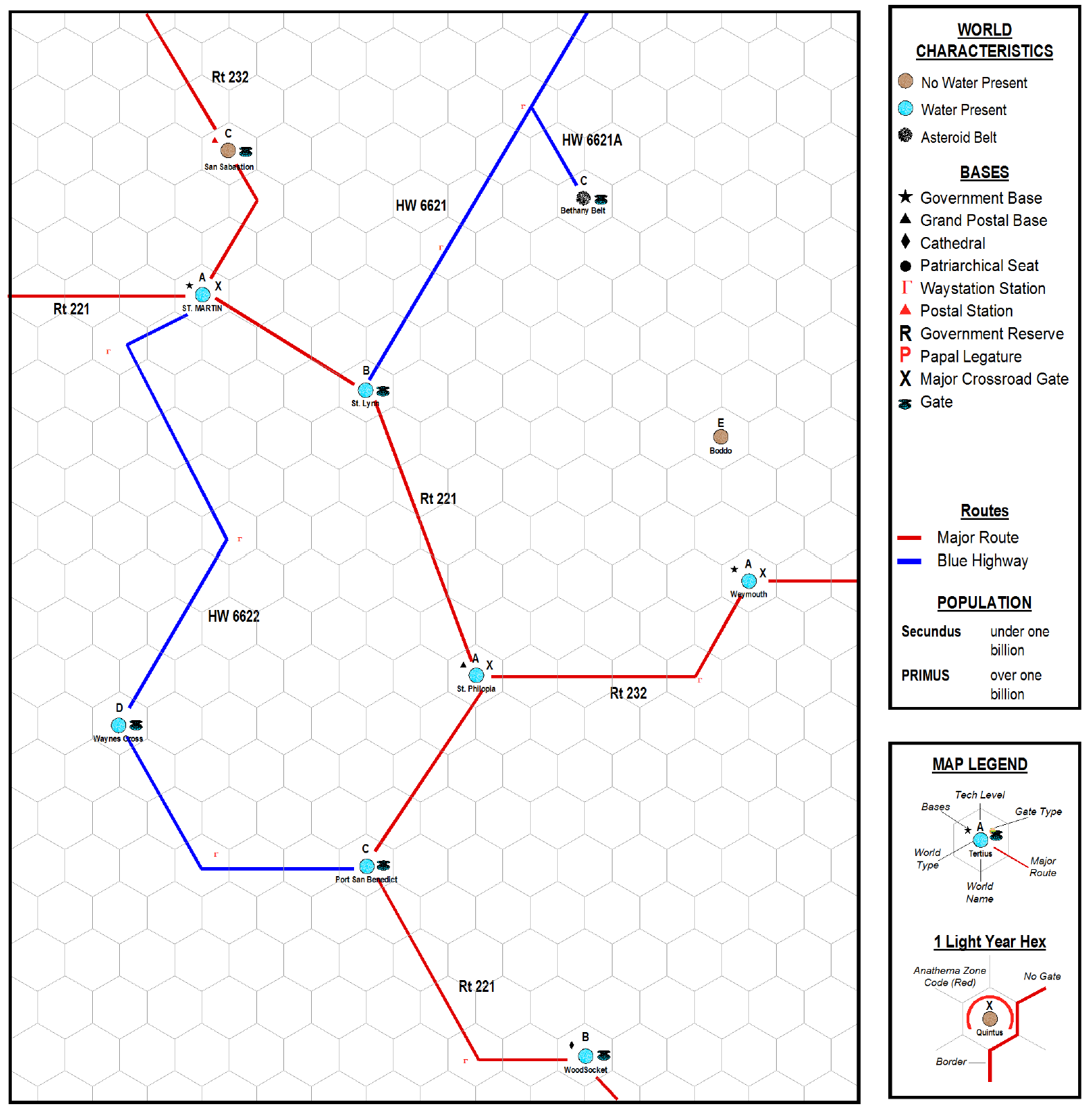
Tuesday, January 18, 2011
The Wilds
The Wilds encompasses a volume greater than all of the rest of known space. It is the area outside the influence of civilization. No subspace roads connect the worlds, not even Blue Highways. There is no postal service of any kind nor even many interstellar governments. Trade is slip shot at best, non-existent at worst. Those ships which ply these areas of subspace are heavily armed and outfitted with sophisticated sensor systems to map subspace and navigate its uncharted routes.
Every year the Midlands expand by a half a light century and the Wilds by double that, as humans venture further into the unknown.
Here there is little law, or the great police state, backwards villages living in the iron age and great cities brushing the tech level of the Highlands.Worlds dedicated to evil and unholy practices and great heroes trying to save them.
This is the great mission area of the Church. Of all of man's organizations only the Church has any kind of regular communication network and influence throughout the Wilds, because it is not really an organization of man.
But there is great danger for the missionaries in the Wilds. They are not alone in proselytizing there. Heretics who rejected the Grand Reunification, Islamics who rejected the Great Compromise, pagans, satanists and even atheists roam the Wilds, as Scripture says, seeking the ruin of souls, or at least their confusion. Not all competitors of the Church are willing to compete on an intellectual level. Indeed not all members of the Church are willing to let vast population labor in error, suffering or threat of death.
If mankind is going to meet others it is in the Wilds that it will happen. Though some believe the Church has spoken out against the possibility of alien intelligent life, of alien's who are ensouled, in truth it has not. Indeed there are deep theological questions involved in the concept. Would such beings be free of Original Sin, walking with God as did Adam & Eve before the fall? If not, did Christ come to save them too? Or did Christ effect their salvation through some other act sometime in the past, or not yet in the future.
This is the sphere of the great heroes and Saints. The province of the grand campaign and great mission, where a single person can change the course of history, with God's provincial help.
Every year the Midlands expand by a half a light century and the Wilds by double that, as humans venture further into the unknown.
Here there is little law, or the great police state, backwards villages living in the iron age and great cities brushing the tech level of the Highlands.Worlds dedicated to evil and unholy practices and great heroes trying to save them.
This is the great mission area of the Church. Of all of man's organizations only the Church has any kind of regular communication network and influence throughout the Wilds, because it is not really an organization of man.
But there is great danger for the missionaries in the Wilds. They are not alone in proselytizing there. Heretics who rejected the Grand Reunification, Islamics who rejected the Great Compromise, pagans, satanists and even atheists roam the Wilds, as Scripture says, seeking the ruin of souls, or at least their confusion. Not all competitors of the Church are willing to compete on an intellectual level. Indeed not all members of the Church are willing to let vast population labor in error, suffering or threat of death.
If mankind is going to meet others it is in the Wilds that it will happen. Though some believe the Church has spoken out against the possibility of alien intelligent life, of alien's who are ensouled, in truth it has not. Indeed there are deep theological questions involved in the concept. Would such beings be free of Original Sin, walking with God as did Adam & Eve before the fall? If not, did Christ come to save them too? Or did Christ effect their salvation through some other act sometime in the past, or not yet in the future.
This is the sphere of the great heroes and Saints. The province of the grand campaign and great mission, where a single person can change the course of history, with God's provincial help.
Monday, January 17, 2011
The Midlands
The major roads of the Midlands primarily consist of Blue Highways. Worlds in the Midlands are beyond the control of the Highland Parliament. The Grand Postal Service does not deliver there, though private express package services connect some of the worlds. Interstellar polities of various sizes and government types exist there. The road networks tend to be held by either private companies, which generally means they are toll roads, or by local governments. Intersection portals tend to tie together systems owned by others, sometimes for tolls, sometimes just to skim what they can off the transshipping traffic. Transmat portal networks are few and far between. Those that do exist tend to be larger commercial units, rather than personnel doorways.
Though the Midlands are beyond the reach of the Highland government it is not beyond the reach of the Church. Many monasteries, convents, hospitals, missions and banks belonging to the Church knits together the Midlands more tightly than if they were not there. The Church maintains its own courier service and transports pilgrims great distances.
Much of the area of the Midlands is only accessible using B/G engines configured for travel off the road network. System beacons guide ships from great distances, though some still get lost. Still some hardy souls run transport trains along the Blue Highways and stages between the other systems.
Without the Pax Terra These governments do sometimes wage war, though rules about damaging gates and subspace superstructure are fairly well followed. There aren't enough hyperspacial drills and beacon portal manufacturing facilities for governments to frivolously destroy those that do exist.
The Grand Human Union is civilization. Every year the Highland Department of Roads spreads Blue Highways and Major Routes farther out, connecting worlds at the Highland border to worlds beyond. Every year the justice of the Highland Rangers and the power of the Star Legion moves farther away from the capital/center of the Highlands, encroaching on the Midlands. Worlds that resist are bypassed, to wither in economic isolation. Worlds that embrace the advancement win seats in the Grand Parliament.
Some flee, further into the Midlands and eventually into the Wilds.
Though the Midlands are beyond the reach of the Highland government it is not beyond the reach of the Church. Many monasteries, convents, hospitals, missions and banks belonging to the Church knits together the Midlands more tightly than if they were not there. The Church maintains its own courier service and transports pilgrims great distances.
Much of the area of the Midlands is only accessible using B/G engines configured for travel off the road network. System beacons guide ships from great distances, though some still get lost. Still some hardy souls run transport trains along the Blue Highways and stages between the other systems.
Without the Pax Terra These governments do sometimes wage war, though rules about damaging gates and subspace superstructure are fairly well followed. There aren't enough hyperspacial drills and beacon portal manufacturing facilities for governments to frivolously destroy those that do exist.
The Grand Human Union is civilization. Every year the Highland Department of Roads spreads Blue Highways and Major Routes farther out, connecting worlds at the Highland border to worlds beyond. Every year the justice of the Highland Rangers and the power of the Star Legion moves farther away from the capital/center of the Highlands, encroaching on the Midlands. Worlds that resist are bypassed, to wither in economic isolation. Worlds that embrace the advancement win seats in the Grand Parliament.
Some flee, further into the Midlands and eventually into the Wilds.
Subscribe to:
Posts (Atom)